Introduction to diving the Egyptian Red Sea
The Red Sea is a long, narrow rift between Africa and Arabia, and Egypt holds its most accessible western shore, from the Sinai peninsula in the north to the Sudanese border in the south. No rivers run into it, so the water stays clear, salty and warm, and its isolation from the Indian Ocean has produced a reef fish community in which roughly one species in seven is found nowhere else. For European divers it is the closest tropical reef, four to five hours from most capitals, which is why Egypt's liveaboard fleet is so large.
The diving splits cleanly into two circuits. The North, sailing from Hurghada or Sharm el-Sheikh, is about wrecks and the reefs of the Strait of Gubal: the SS Thistlegorm, the four ships piled on Abu Nuhas, the Dunraven, and the walls of Ras Mohammed at the tip of Sinai. The South, sailing from Port Ghalib, Marsa Alam or Hamata, is about offshore reefs. The Brothers, Daedalus and Elphinstone (BDE) route is a shark itinerary with long crossings and steep walls; St John's and Fury Shoals is a gentler route of coral gardens, caves and dolphins near the Sudanese border. Combination trips exist, but a week is normally one or the other.
How the fleet works
Egyptian liveaboards are typically 30 to 40 m steel or wooden motor yachts carrying 20 to 26 divers, sailing Saturday to Saturday or Thursday to Thursday to match charter flights. Diving is from the mothership or from inflatable tenders, three or four dives a day, guided. Nitrox is common and often included. Prices are among the lowest per dive of any liveaboard destination, but the quality range across the fleet is wide, so operator reputation matters more here than almost anywhere.
Since a series of shark incidents in the late 2010s, the Chamber of Diving and Watersports (CDWS) has tightened the rules on the offshore reefs: minimum dive counts, no snorkeling at the Brothers, Daedalus and Elphinstone, no night dives at the Brothers, and restrictions on where boats may moor. A good operator will explain the current version at the briefing.
Why dive the Egyptian Red Sea
Few places combine world-class wrecks, big sharks, pristine coral and a low price on the same coastline, and even fewer are a short flight from Europe. Whatever you want from a week on a boat, one of the Egyptian routes delivers it.
- The Thistlegorm: a British supply ship sunk in 1941 with its cargo of trucks, motorcycles, rifles and a locomotive still in the holds. Two dives are never enough.
- Oceanic sharks in season: oceanic whitetips patrol the Brothers and Elphinstone from roughly October to December, and scalloped hammerheads school off Daedalus in summer.
- Coral that is still healthy: the southern reefs of St John's and Fury Shoals hold some of the densest hard-coral cover left in the region, with caves and swim-throughs cut through them.
- Dolphins and dugongs: resident spinner dolphins at Sataya and Sha'ab Samadai, and dugongs grazing the seagrass at Abu Dabbab and Marsa Mubarak near Marsa Alam.
- A dive for every level: Hurghada day boats and northern liveaboards suit newer divers; BDE rewards experience with walls that drop into the blue.
- Value: more dives per euro than any comparable tropical liveaboard destination, with flights from most of Europe under five hours.
Dive sites in the Egyptian Red Sea
The sites run north to south: three from the northern circuit, then the offshore and deep-south reefs reached by liveaboard from Marsa Alam, Port Ghalib or Hamata.
Ras Mohammed: Shark and Yolanda Reef (Sinai)
Two pinnacles at the tip of Sinai where the Gulfs of Suez and Aqaba meet. Shark Reef is a sheer wall with schooling barracuda, snapper and batfish in summer; Yolanda Reef carries the cargo of a freighter wrecked in 1980, a field of bathtubs and toilets on the sand.
SS Thistlegorm (Sha'ab Ali, Strait of Gubal)
A 128 m British supply ship bombed and sunk in October 1941 while waiting to enter the Suez Canal. She lies upright in 30 m with the deck around 16 m, her holds full of Bedford trucks, motorcycles and rifles; two locomotives lie on the seabed beside her. Dived in two halves from a mooring line.
Abu Nuhas (Strait of Gubal)
A reef in a shipping lane that has claimed four diveable wrecks: the Giannis D (1983), the Carnatic (1869), the Chrisoula K (1981) and the Kimon M (1978). All lie between 5 and 30 m on the north side, close enough to dive two in a day. The Giannis D's tilted engine room is the highlight. Most northern routes add the Dunraven, an 1876 steamship lying upside down at Beacon Rock in 18 to 30 m.
Elphinstone Reef (Marsa Alam)
A 300 m long reef 12 km offshore with plateaus at both ends dropping into the blue. Oceanic whitetip sharks patrol the surface layers from about October to December, and grey reef sharks hold on the north plateau. Reachable by day boat from Marsa Alam, for experienced divers only.
Brothers Islands (offshore, Marsa Alam)
Two rocky islets 60 km offshore. Big Brother has a lighthouse, two wrecks on its wall (the Numidia and the Aida) and thresher sharks on the deep plateau; Small Brother has a soft-coral wall and grey reef sharks. Oceanic whitetips are frequently seen under the boats in autumn.
Daedalus Reef (offshore)
An isolated reef with a lighthouse, 90 km off the coast. Scalloped hammerheads school off the north point in summer and oceanic whitetips arrive in autumn. Anemone City on the east side is among the most photographed reef scenes in the Red Sea.
St John's and Rocky Island (Deep South)
Near the Sudanese border, St John's is a group of reefs with cave systems (Umm Kharerim, Sha'ab Claudio) and hard coral that looks untouched; Habili Ali attracts grey reef sharks and mantas in season. Rocky Island and Zabargad, further north, add steep walls and, on calm days, hammerheads.
Marine life in the Egyptian Red Sea
The Red Sea's isolation has produced a reef community with a high share of endemic species, and its offshore reefs act as waystations for oceanic sharks on the move between the Indian Ocean and the Gulf of Aqaba.
Pelagics and big animals
- Oceanic whitetip sharks at the Brothers, Daedalus and Elphinstone, most reliable October to December
- Scalloped hammerheads schooling at Daedalus and Rocky Island in summer
- Grey reef, silky and silvertip sharks on the offshore walls; thresher sharks on Big Brother's deep plateau
- Spinner and bottlenose dolphins at Sataya, Sha'ab Samadai and around Hurghada
- Dugongs on the seagrass at Abu Dabbab and Marsa Mubarak; green turtles in the same bays
- Reef mantas occasionally at Habili Ali and Daedalus in late spring and summer
Reef
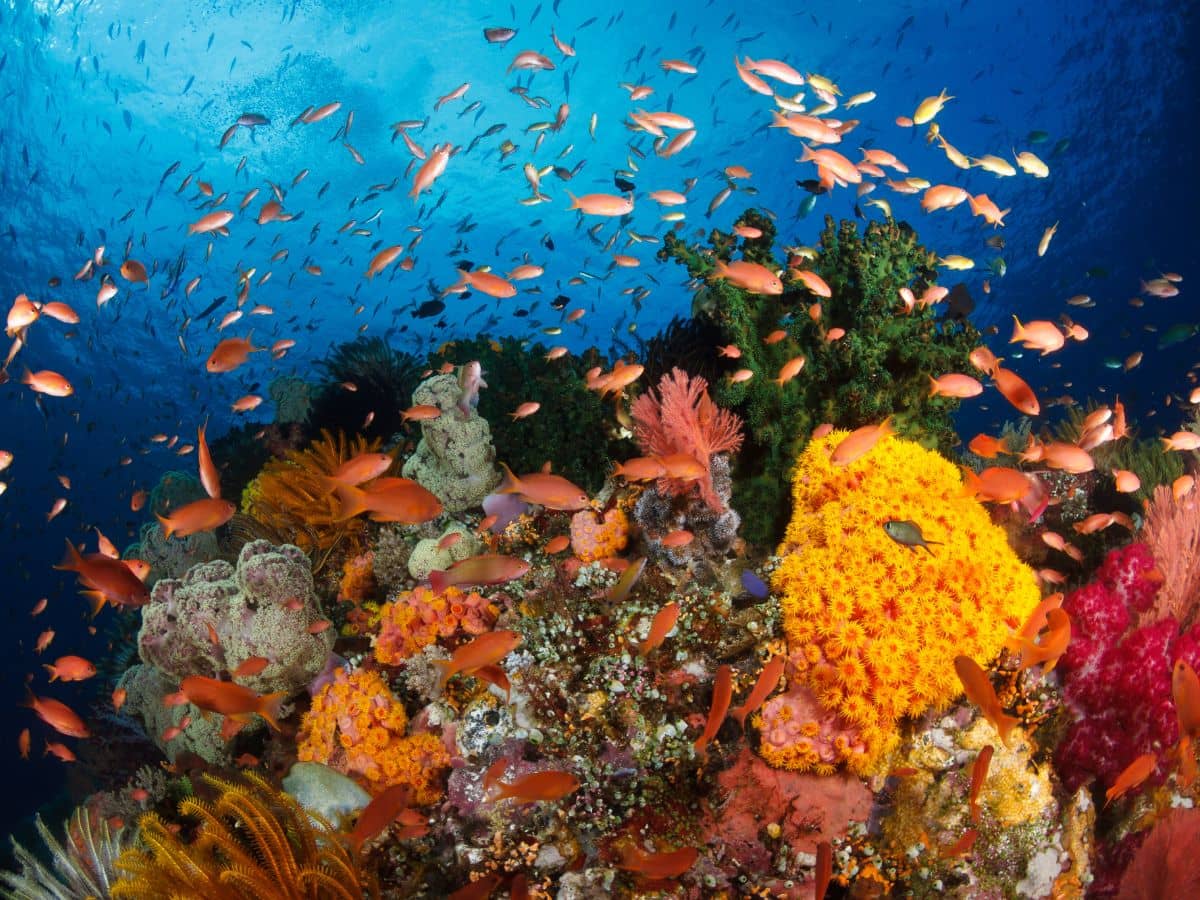
- Napoleon wrasse, bumphead parrotfish, giant morays and clouds of orange anthias on every reef
- Endemic Red Sea species such as the masked butterflyfish, Red Sea bannerfish and Arabian angelfish
- Barracuda, snapper and batfish schooling at Ras Mohammed in June and July
- Soft coral on the walls of Small Brother and dense hard coral at St John's and Fury Shoals
Macro and wrecks
- Crocodilefish, scorpionfish, stonefish and blue-spotted rays on the sand
- Nudibranchs, pipefish and glassfish inside the wrecks and caves
- Lionfish and moray eels hunting on night dives on the northern reefs
Dive conditions in the Egyptian Red Sea
Water temperature swings more than in most tropical destinations: around 21 to 23 C in January and February, 24 to 26 C in spring and autumn, and 28 to 30 C in August. A 5 mm suit is right for most of the year and a 7 mm or a hooded vest for winter; a 3 mm is fine only from June to September. Air can be cold on deck in winter and above 40 C in summer.
Visibility is typically 20 to 40 m, better on the offshore reefs than in the Strait of Gubal, where the wrecks sit in 15 to 25 m of visibility. Current on the northern wrecks and at Ras Mohammed can be strong and is why Thistlegorm dives use a mooring line. The offshore reefs are open-ocean sites: unpredictable current, deep blue-water safety stops, and drift pickups by tender, which is what the experience rules are for.
Open Water divers are welcome on the northern routes and at Hurghada or Marsa Alam day-boat sites. For the Brothers, Daedalus, Elphinstone, Rocky and Zabargad, Egyptian rules require approximately 50 logged dives and Advanced Open Water or equivalent, and operators check logbooks at boarding. Nitrox is available on nearly every liveaboard, often free.
Red Sea Egypt through the year
Water and air temperature, visibility and rainfall for every month, with the windows we would book ourselves. Hover or tap a month for the detail.
- Water
- Air
- Visibility
- Rain
Show the monthly data as a table
| Month | Water °C | Air °C | Visibility | Rain | Diving | Notes |
|---|---|---|---|---|---|---|
| Jan | 21–23 °C | 10–22 °C | 20–40 m | 2 mm | Good | Coldest water, clear, lowest prices |
| Feb | 21–22 °C | 11–23 °C | 20–40 m | 1 mm | Good | Cold wind on deck, 7 mm territory |
| Mar | 22–23 °C | 14–26 °C | 20–40 m | 1 mm | Peak | Season opens fully, comfortable on deck |
| Apr | 23–24 °C | 18–30 °C | 20–40 m | 1 mm | Peak | Good visibility, both circuits busy |
| May | 25–26 °C | 22–34 °C | 20–40 m | 0 mm | Peak | First hammerhead schools at Daedalus |
| Jun | 26–28 °C | 25–36 °C | 20–35 m | 0 mm | Good | Hammerhead peak, fish schools at Ras Mohammed |
| Jul | 27–29 °C | 26–37 °C | 20–35 m | 0 mm | Good | Hot on deck, warm water, hammerheads |
| Aug | 28–30 °C | 27–37 °C | 20–35 m | 0 mm | Good | Warmest water of the year |
| Sep | 27–29 °C | 24–35 °C | 20–40 m | 0 mm | Peak | Calm seas for offshore crossings |
| Oct | 26–28 °C | 20–31 °C | 25–40 m | 1 mm | Peak | Oceanic whitetips arrive at Brothers, Elphinstone |
| Nov | 24–26 °C | 16–27 °C | 25–40 m | 2 mm | Peak | Oceanic whitetip peak, comfortable air |
| Dec | 23–24 °C | 12–23 °C | 20–40 m | 2 mm | Good | Last oceanic whitetips, cooling fast |
Best time to visit Red Sea Egypt
The Egyptian Red Sea is diveable all year. The question is which combination of water temperature, sharks and crowds you prefer, because each season trades one against another.
- March to May: comfortable air temperatures, water warming from 23 to 26 C, good visibility and the first hammerheads at Daedalus toward the end. A busy and reliable window for both circuits.
- June to August: hot on deck (35 to 40 C) but the warmest water, at 28 to 30 C, and the peak for schooling hammerheads at Daedalus and for fish aggregations at Ras Mohammed. Fewer European divers in the heat means space on the boats.
- September to November: arguably the sweet spot. Water still 26 to 28 C, calmer seas for the offshore crossings, and oceanic whitetips arriving at the Brothers and Elphinstone from October.
- December to February: cool water (21 to 23 C) and cold wind on deck, but oceanic whitetips through December, clear water, and the lowest prices. Wrecks and the northern reefs are unaffected; some southern boats reposition or run shorter routes.
- Dolphins and dugongs: resident year-round at Sataya, Samadai and the Marsa Alam bays, with calmer summer seas making sightings easier.
Getting to the Egyptian Red Sea
Three airports serve the diving coast. Hurghada (HRG) is the main gateway for northern liveaboards and day boats, with year-round scheduled and charter flights from most of Europe, the Gulf and Cairo. Marsa Alam (RMF) is the gateway for southern routes, with charter flights from Europe and connections via Cairo; Port Ghalib marina is ten minutes from the terminal. Sharm el-Sheikh (SSH) on the Sinai side is used by some northern boats and by day-boat divers heading to Ras Mohammed and the Straits of Tiran.
Typical embarkation ports are Hurghada marina for the North, Port Ghalib or Marsa Alam marina for BDE, and Hamata for St John's and Fury Shoals, which is a two- to three-hour road transfer south of Marsa Alam airport. Boats normally board on the afternoon of arrival and sail the following morning after paperwork and check dives. Sharm el-Sheikh boats depart from Travco marina.
Most nationalities obtain a single-entry tourist visa for USD 25, either as an e-visa in advance or on arrival at the bank counters before immigration. Visitors flying into Sharm el-Sheikh and staying within South Sinai can use a free 15-day Sinai-only stamp, which does not cover a liveaboard sailing from Hurghada. Passports need six months of validity. Allow a full day between the last dive and the flight home; most itineraries end diving the day before disembarkation for this reason.
Getting to Red Sea Egypt, and what to know before you go
Northern liveaboards embark at Hurghada marina, 15 to 20 min from the airport
Port Ghalib marina 10 min; Hamata (St John's boats) 2 to 3 h by road
Travco marina and Naama Bay dive centers 15 to 20 min; Sinai-only stamp does not cover Hurghada departures
Domestic flight to HRG, RMF or SSH, approximately 1 h
Hurghada · Port Ghalib · Marsa Alam · Hamata · Sharm el-Sheikh
- Best season
- Mar–May and Sep–Nov
- Off season
- Dec–Feb (cool water and wind; diving continues, some southern boats reposition)
- Typical trip
- 7 nights (some 10- and 14-night combinations)
- Experience
- OW, about 50 logged dives
- Park / marine fee
- Marine park and port fees approximately EUR 50 to 100 per person per week on liveaboards, paid in cash on board; Ras Mohammed day entry approximately EUR 5 to 10
- Visa
- Single-entry tourist visa USD 25, e-visa or on arrival; free 15-day Sinai-only stamp at SSH does not cover Hurghada or Marsa Alam
- Nitrox
- Available on nearly every liveaboard, often included
- Currency
- Egyptian pound (EGP); euros and US dollars accepted on boats
- Language
- Arabic; English spoken throughout the dive industry
- Time zone
- UTC+2 (UTC+3 with summer time)
- Power
- Type C/F, 220 V
- Oceanic whitetip shark
- Scalloped hammerhead
- Grey reef shark
- Thresher shark
- Spinner dolphin
- Dugong
- Napoleon wrasse
- Green turtle
| Species | Months | Where |
|---|---|---|
| Oceanic whitetip shark | Oct–Dec | Brothers, Elphinstone, Daedalus |
| Scalloped hammerhead | May–Aug | Daedalus north point, Rocky Island |
| Thresher shark | Nov–Apr | Big Brother deep plateau |
| Spinner dolphin | Year-round | Sataya, Sha'ab Samadai |
| Dugong | Year-round | Abu Dabbab, Marsa Mubarak |
| Schooling barracuda and snapper | Jun–Jul | Ras Mohammed, Shark Reef |
Seasons are typical, not guaranteed: sightings depend on currents, weather and luck.
Practical information
Marine park and port fees are charged separately from the trip price on almost every Egyptian liveaboard and paid in cash on board: approximately EUR 50 to 100 per person per week depending on route, with the offshore BDE and Deep South itineraries at the top of that range. Day-boat divers pay Ras Mohammed National Park entry of approximately EUR 5 to 10 per day. Crew tips are expected, commonly EUR 30 to 50 per person per week, pooled. Bring euros or US dollars in cash; cards work in hotels and marinas but rarely on the boat.
The currency is the Egyptian pound (EGP), plugs are type C and F at 220 V, and the language is Arabic with English used throughout the dive industry. Dive insurance with hyperbaric cover is compulsory for liveaboards; chambers operate in Hurghada, Sharm el-Sheikh and Marsa Alam. Nitrox is available on nearly every boat, often included. Egyptian regulations set approximately 50 logged dives as the minimum for the Brothers, Daedalus, Elphinstone, Rocky and Zabargad, and ban snorkeling at those reefs.
Tips & recommendations
- Match the route to your logbook: under 50 dives means the North; the wrecks are outstanding and there is no reason to argue with the offshore rules.
- Bring your logbook, physically or digitally: guides check dive counts and certification cards before the boat sails on BDE and Deep South routes.
- Dress warmer than you think: outside July to September a 5 mm suit is the sensible choice, and in winter a hooded vest makes the fourth dive bearable.
- Carry a surface marker buoy and a reel: offshore dives end in the blue with a tender pickup. An SMB is compulsory on most boats and you should be able to deploy it from depth.
- Cash for fees and tips: park fees, port fees, nitrox and tips are collected in euros or dollars on board, usually EUR 100 to 200 in total for a week.
- Read the operator, not just the itinerary: the fleet's quality range is wide. Recent reviews on maintenance, group sizes and guide-to-diver ratio say more than the boat's photos.
- Book the Thistlegorm early in the week: ask how many dives the schedule gives it; two dives on the wreck is standard and worth confirming.