Introduction to diving Papua New Guinea
Papua New Guinea occupies the eastern half of New Guinea plus around 600 offshore islands, and its reefs sit at the northern apex of the Coral Triangle. There is no single dive destination here. Four areas carry almost all the diving: Milne Bay at the far eastern tip, Kimbe Bay on the north coast of New Britain, the fjord coastline at Tufi in Oro Province, and the volcanic Witu Islands out in the Bismarck Sea. Each has its own airport, its own character and its own weather pattern.
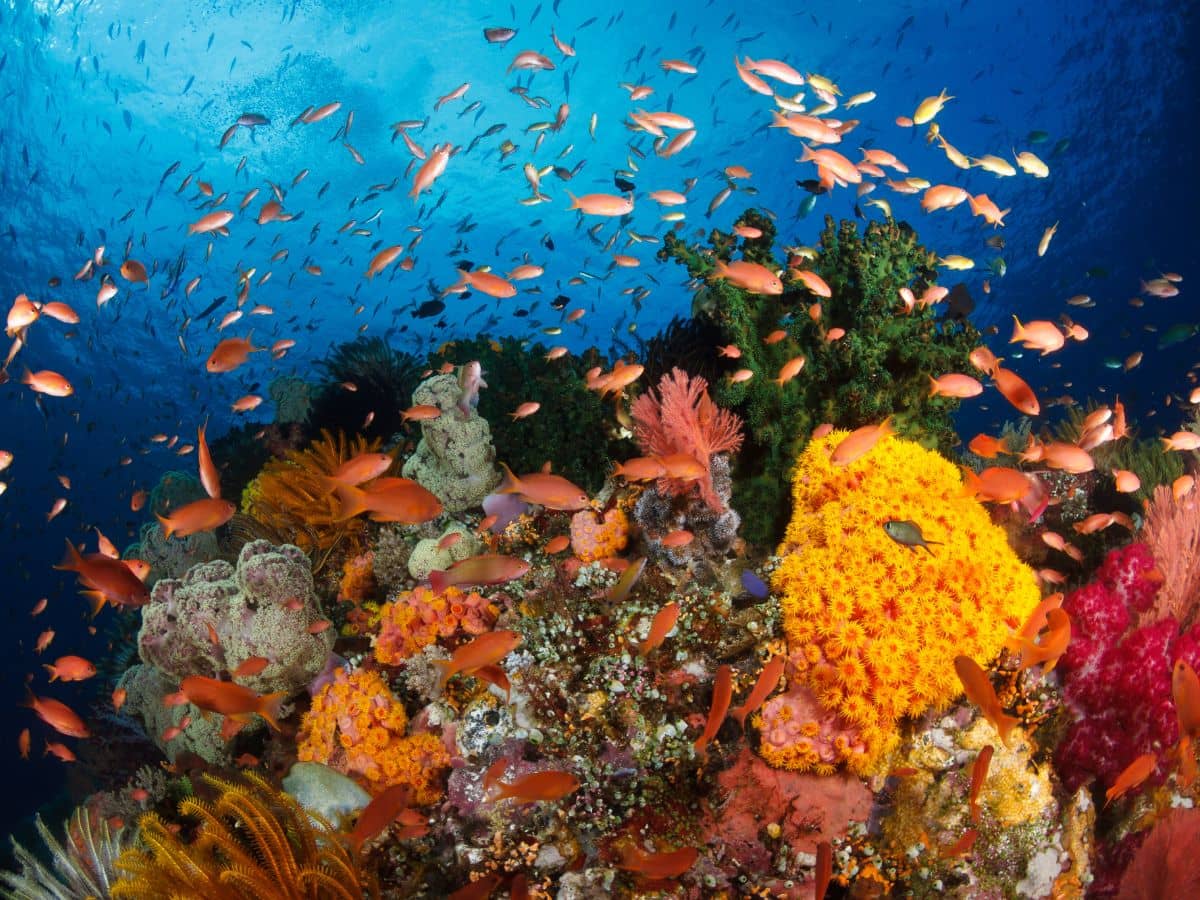
Milne Bay is where muck diving was named and popularised in the 1980s, and the black-sand slopes at Dinah's Beach and Lauadi still deliver mandarinfish, ghost pipefish and blue-ringed octopus alongside genuinely good hard-coral reefs. Kimbe Bay is the opposite: deep blue water with isolated seamounts rising to within a few metres of the surface, surveyed by The Nature Conservancy and found to hold more than 800 fish species and over 400 species of coral in an area smaller than many marine parks.
Small operations, few divers
The infrastructure is modest and that is part of the appeal. A handful of shore-based resorts and a small liveaboard fleet cover the whole country, and it is normal to dive a world-class seamount with only your own boat on it. The flip side is logistics: domestic flights are limited, they do go wrong, and baggage allowances on the smaller aircraft are tight. Almost every itinerary is built around a domestic connection from Port Moresby, so a spare day at each end is not optional.
Reefs in Papua New Guinea are under customary ownership. Villages hold traditional rights over the water in front of their land, and operators pay reef-access fees to landowners, normally folded into the price of the trip. It is worth knowing, because it explains why guides ask permission before diving certain sites and why some reefs are closed at short notice for local reasons.
Why dive Papua New Guinea
Papua New Guinea offers the same coral diversity as its better-known neighbours with almost none of the crowding, and enough variety that a two-week trip never repeats itself.
- Coral Triangle diversity without the boats: Kimbe Bay records over 800 fish and 400 coral species, and most sites see a single dive boat a day or none at all.
- The birthplace of muck diving: the black-sand slopes of Milne Bay produce mandarinfish, lacy scorpionfish, blue-ringed octopus, ghost pipefish and every flavour of nudibranch.
- Seamounts that hold fish: Inglis Shoal and Bradford Shoals rise from deep water and gather barracuda, jacks, dogtooth tuna and, on the outer shoals, scalloped hammerheads.
- WWII wrecks in clear warm water: the Black Jack B-17 sits upright and intact at 45 m off Boga Boga, and Japanese aircraft and small freighters lie around Rabaul and Milne Bay.
- Fjord diving at Tufi: drowned river valleys give sheltered muck dives inside the fjords, and offshore reefs and pinnacles a short run outside them.
- Warm water all year: 27 to 30C every month, so the season is about wind and rain rather than temperature.
Dive sites in Papua New Guinea
Sites are grouped by base rather than by a single itinerary. Resort divers stay within an hour or so of Alotau, Kimbe, Tufi or Rabaul; liveaboards link Kimbe Bay with the Witu Islands and Fathers Reefs, or work Milne Bay and the Cape Vogel coast.
Deacon's Reef and Observation Point (Milne Bay)
A coral slope on the north shore of Milne Bay with soft coral, crinoids and dense small-fish life over a wall that drops into the bay. It is the site most often used to show what Milne Bay reef diving is, and the shallows along the shore are muck, so a single mooring can give both.
Dinah's Beach and Lauadi (Milne Bay)
The black-sand slope that gave muck diving its name. Rubble and volcanic sand from 5 to 30 m holding mandarinfish at dusk, flamboyant cuttlefish, ghost pipefish, frogfish, hairy octopus and seahorses, with a coral shelf at the top for the safety stop.
Black Jack B-17 (Boga Boga, Cape Vogel)
A Boeing B-17F that ditched offshore in 1943 and sits upright and largely intact on sand at 45 m, all four engines and the turret in place. It is a deep, short, advanced dive, usually run as a single dive from a liveaboard or from Tufi, and conditions have to be right.
Inglis Shoal (Kimbe Bay)
A seamount rising from deep water to about 8 m, and the site most Kimbe Bay divers remember. The top is covered in hard coral and anthias, the flanks hold gorgonians and barrel sponges, and the blue side gathers barracuda, big-eye trevally and dogtooth tuna when current runs.
Bradford Shoals (Kimbe Bay)
An offshore seamount an hour or more out, topping out around 25 m, so this is a deeper dive with real current. It is the Kimbe site with the best chance of scalloped hammerheads and grey reef sharks, and the schools of barracuda over the summit can be enormous.
Restorf Island (Kimbe Bay)
A small island with a sheltered reef wall, easy conditions and outstanding coral in the shallows, plus resident hawksbill turtles and the odd pilot whale passing in the deep water beyond. It works as a check dive, a night dive and a photographic site all at once.
Cyclone Reef and the Tufi fjords
Outside the fjord mouths, Cyclone Reef and Stewart Reef are offshore pinnacles with fans, sharks and schooling fish in clear water. Inside, the fjord walls at Tufi Wharf are a sheltered muck dive with pipefish, seahorses and lionfish, dived at any state of the weather.
Lama Shoals (Witu Islands)
A liveaboard site on a volcanic shoal in the Bismarck Sea, known for extraordinary soft-coral colour, crinoids and rhinopias, with sharks and rays over the deeper slope. The Witu group is a full day of steaming from Kimbe and only reachable by boat.
Marine life in Papua New Guinea
Papua New Guinea lies inside the Coral Triangle, and survey work in Kimbe Bay alone has recorded more than 800 reef fish species and over 400 coral species. The country combines critter diving that rivals anywhere in Asia with healthy reef and seamount fish life, which is unusual in one destination.
Macro and muck
- Mandarinfish spawning at dusk over rubble at Dinah's Beach and Lauadi.
- Lacy scorpionfish and other rhinopias, one of the signature finds of the country, on reef and rubble slopes.
- Pygmy seahorses on the deeper gorgonians, plus ornate and robust ghost pipefish.
- Blue-ringed octopus, hairy octopus, flamboyant cuttlefish and mimic octopus on the black sand.
- Nudibranchs and flatworms in numbers that reward a slow dive and a good guide.
Reef and pelagic
- Chevron and blackfin barracuda in tornado schools over the Kimbe Bay seamounts.
- Grey reef and whitetip sharks on the outer shoals, with scalloped hammerheads possible at Bradford Shoals.
- Big-eye trevally, dogtooth tuna and rainbow runners where current hits the pinnacles.
- Hawksbill and green turtles, Napoleon wrasse and bumphead parrotfish on the reef tops.
- Reef manta rays at the cleaning stations off Gona Bara Bara in Milne Bay.
Above and around
- Spinner dolphins and pilot whales in the deep water of Kimbe Bay between reefs.
- Sperm whales and orcas seen occasionally on the crossings, not on dives.
- Extensive soft-coral and gorgonian cover on the Witu and Fathers Reefs walls.
Dive conditions
Water is 27 to 30C all year, coolest around August and warmest from December to March. A 3 mm full suit is the standard choice; divers doing four dives a day, or long muck dives kneeling on sand, often prefer 5 mm or a hooded vest.
Visibility is typically 20 to 40 m, best from September to December and reduced to 15 to 25 m during the northwest monsoon from January to March when river runoff reaches the coast. Muck sites are always less clear than the reefs, and that is normal rather than a bad day.
Conditions vary by area. Kimbe Bay faces north and is sheltered during the southeast trades from May to October, while Milne Bay is exposed at the eastern tip and is calmest from September to January. Currents on the Kimbe seamounts and the outer shoals can be strong, and the sites there are drift or live-boat dives with a surface marker buoy. Operators generally expect Advanced Open Water or equivalent and around 20 logged dives, more for the Black Jack B-17 at 45 m. Nitrox is available at the main resorts and on most liveaboards. Recompression chamber access is limited, so evacuation insurance is essential and conservative profiles are the norm.
Papua New Guinea through the year
Water and air temperature, visibility and rainfall for every month, with the windows we would book ourselves. Hover or tap a month for the detail.
- Water
- Air
- Visibility
- Rain
Show the monthly data as a table
| Month | Water °C | Air °C | Visibility | Rain | Diving | Notes |
|---|---|---|---|---|---|---|
| Jan | 29–30 °C | 24–31 °C | 15–25 m | 350 mm | Possible | Northwest monsoon; wettest, vis down |
| Feb | 29–30 °C | 24–31 °C | 15–25 m | 330 mm | Possible | Wet and windy; some boats off charter |
| Mar | 29–30 °C | 24–31 °C | 15–30 m | 350 mm | Possible | Monsoon easing; Milne Bay unsettled |
| Apr | 29–30 °C | 24–31 °C | 20–30 m | 300 mm | Good | Transition; Kimbe Bay settles first |
| May | 28–29 °C | 23–31 °C | 20–35 m | 250 mm | Good | Southeast trades; calm in Kimbe Bay |
| Jun | 28–29 °C | 23–30 °C | 25–35 m | 200 mm | Good | Dry and breezy; good Kimbe visibility |
| Jul | 27–29 °C | 23–30 °C | 25–40 m | 180 mm | Good | Coolest water; steady trade winds |
| Aug | 27–28 °C | 23–30 °C | 25–40 m | 160 mm | Good | Windy outside; sheltered reefs fine |
| Sep | 27–29 °C | 23–31 °C | 25–40 m | 150 mm | Peak | Trades ease; liveaboard season opens |
| Oct | 28–29 °C | 24–31 °C | 25–40 m | 180 mm | Peak | Calm seas; best all-round conditions |
| Nov | 28–30 °C | 24–32 °C | 25–40 m | 220 mm | Peak | Peak season; Milne Bay at its best |
| Dec | 29–30 °C | 24–32 °C | 20–35 m | 300 mm | Peak | Warm, calm, occasional squalls |
Best time to visit Papua New Guinea
Papua New Guinea can be dived all year, but the two monsoons move the good conditions around the country. The southeast trades run roughly May to October and the northwest monsoon January to March, with transitions either side. The broad answer is that September to December is the strongest window nationally.
- September to December: the best all-round period. Milne Bay is at its calmest, the liveaboard season is in full swing, visibility is at its best and seas are settled for the offshore shoals.
- January to March: the northwest monsoon brings the heaviest rain, the most wind on the north coast and reduced visibility from runoff. Some boats reposition or go off charter.
- April to June: a good transitional window, especially in Kimbe Bay, which settles before Milne Bay does. Fewer visitors and green, spectacular landscapes.
- July to August: the southeast trades blow hardest. Kimbe Bay, facing north, stays workable and the water is at its coolest and clearest; exposed sites in Milne Bay can be wind-bound.
Getting to Papua New Guinea
Every itinerary runs through Port Moresby Jacksons International (POM). The main international routes are from Brisbane, Cairns and Sydney, plus Singapore, Manila and Hong Kong. From Port Moresby you take a domestic flight to your base: Gurney (GUR) near Alotau for Milne Bay, Hoskins (HKN) for Kimbe Bay, or Tufi (TFI) for the fjords. Rabaul and Kavieng, used by some liveaboard itineraries, have their own airports at Tokua and Kavieng.
Domestic flights are limited in frequency and cancellations happen, so plan at least one night in Port Moresby or an early arrival before an embarkation, and never book an international departure on the same day as a domestic return. Baggage allowance on domestic sectors is lower than on international flights and excess is charged by the kilo, which matters if you carry camera gear.
Transfers from the airports are arranged by the resorts and are usually short: Hoskins to the Kimbe Bay resorts is around 45 to 60 minutes, and Gurney to Alotau harbour about 20 minutes. Liveaboards embark at Kimbe, Alotau, Rabaul or Kavieng depending on the itinerary.
Most nationalities need a visa. A 60-day visitor visa is available on arrival at Port Moresby for many passports and an e-visa system also operates, but rules change, so confirm the current position before booking.
Getting to Papua New Guinea, and what to know before you go
About 20 min by road to Alotau harbour for Milne Bay resorts and liveaboards
About 45 to 60 min by road to the Kimbe Bay resorts
All domestic connections to GUR, HKN and TFI depart here; overnight recommended
Short pickup to the fjord-side resort and its jetty
Alotau · Kimbe · Rabaul · Kavieng
- Best season
- Sep–Dec
- Off season
- Jan–Mar (northwest monsoon: heavy rain, wind, reduced visibility)
- Typical trip
- 7–10 nights (resort or liveaboard); 14 to combine two areas
- Experience
- AOW, about 20 logged dives
- Park / marine fee
- No national park fee. Reefs are under customary landowner ownership and operators pay village reef-access fees, normally included in the trip price
- Visa
- Visa required for most nationalities; 60-day visa on arrival at Port Moresby or e-visa for many passports
- Nitrox
- Available at the main resorts and on most liveaboards, usually at extra cost
- Currency
- PNG kina (PGK); cash needed outside Port Moresby
- Language
- Tok Pisin, English and Hiri Motu official; English used throughout the dive industry
- Time zone
- UTC+10 (PGT)
- Power
- Type I, 240 V
- Pygmy seahorse
- Lacy scorpionfish
- Mandarinfish
- Chevron barracuda
- Scalloped hammerhead
- Grey reef shark
- Hawksbill turtle
- Blue-ringed octopus
| Species | Months | Where |
|---|---|---|
| Scalloped hammerhead | Sep–Jan | Bradford Shoals and the outer Kimbe Bay seamounts, deep and early |
| Reef manta ray | Sep–Dec | Gona Bara Bara cleaning stations, Milne Bay |
| Mandarinfish | Year-round | Dusk over rubble at Dinahs Beach and Lauadi, Milne Bay |
| Lacy scorpionfish | Year-round | Kimbe Bay and Milne Bay reef and rubble slopes |
| Chevron barracuda | Year-round, best Sep–Dec | Inglis Shoal and Bradford Shoals summits |
| Pilot whales and spinner dolphins | Year-round | Deep water of Kimbe Bay between the seamounts |
Seasons are typical, not guaranteed: sightings depend on currents, weather and luck.
Practical information
Reef fees: there is no national park fee. Reefs are under customary landowner ownership and operators pay village reef-access fees, normally included in the resort or trip price. Some provinces add a small levy; confirm at booking.
Health: malaria is present year round across coastal Papua New Guinea. Prophylaxis is recommended, along with repellent and covered clothing at dusk. Dengue also occurs. Take advice from a travel clinic well before departure.
Money: the currency is the PNG kina (PGK). Cards work at hotels in Port Moresby and at some resorts, but cash is needed almost everywhere else, including for tips, carvings and village fees. ATMs exist in the towns and not at the dive bases.
Diving: nitrox is available at the main resorts and on most liveaboards, usually at extra cost. Dive insurance covering evacuation is expected; chamber access is limited and evacuation means a flight to Port Moresby or Australia.
Practicalities: 240 V with type I sockets, the same as Australia. Tok Pisin, English and Hiri Motu are the official languages and English is used throughout the dive industry. Time is UTC+10.
Tips & recommendations
- Build in buffer days: domestic flights get cancelled. A night in Port Moresby before and after the dive week saves the trip more often than you would expect.
- Watch the domestic baggage limit: allowances are lower than on international sectors and camera gear pushes you over quickly; ask your operator what your route allows.
- Start malaria prophylaxis on schedule: most regimens need to begin before arrival, so see a travel clinic weeks ahead, not days.
- Bring cash in kina: outside Port Moresby, cards are of limited use and there are no ATMs at the dive bases.
- Take macro and wide-angle: a single day can include a black-sand muck slope and a barracuda-covered seamount, so plan the ports and lenses in advance.
- Dive at dusk for mandarinfish: Dinah's Beach and Lauadi produce them reliably in the last half hour of light.
- Respect customary ownership: ask before photographing people or villages, and follow your guide on which reefs are open.