Introduction to diving Ningaloo Reef
Ningaloo Reef runs about 260 km along the North West Cape of Western Australia, from Exmouth Gulf in the north to Red Bluff in the south, and it is the largest fringing reef in Australia. Unlike the Great Barrier Reef, which sits tens of kilometres offshore, Ningaloo comes right up to the beach: in places you can walk in from the sand and be over coral in two minutes. The reef, the adjacent Cape Range peninsula and the Muiron Islands were inscribed as a UNESCO World Heritage Site in 2011.
Two towns serve the reef. Exmouth sits at the northern tip and is the base for the whale shark and humpback tours, the Navy Pier, the Muiron Islands and the Lighthouse Bay sites off the cape. Coral Bay, about 150 km south, is a much smaller settlement on a sheltered bay with easy shore snorkelling, the Bateman Bay manta cleaning stations and its own day boats. Both are small, seasonal and busy in the middle of the year.
A reef built around seasons
Ningaloo diving is defined by a calendar rather than by sites. Mass coral spawning in March triggers a plankton bloom that draws whale sharks, which stay from mid-March until roughly the end of July. Humpback whales move up and down the coast from June, with licensed in-water swims running from August to October. Reef mantas are around all year and peak in the cooler months, and turtles nest on the beaches from November to February with hatchlings from January.
Interactions with whale sharks and humpbacks are strictly regulated by the Western Australian Department of Biodiversity, Conservation and Attractions. Only licensed operators can run them, spotter aircraft are used to find the animals, group sizes and minimum distances are set by the licence, and the tours are snorkel-based, not dives. Scuba diving is a separate activity, run on the outer reef, at Navy Pier or around the Muiron Islands.
Why dive Ningaloo Reef
Ningaloo combines big-animal encounters with genuinely good reef diving in an easy, well-run destination that needs no boat travel longer than an hour.
- The most reliable whale shark season anywhere: from mid-March to the end of July, licensed boats with spotter planes deliver a very high success rate on the outer reef off Tantabiddi.
- Humpback whale swims: Ningaloo is one of very few places worldwide licensed for in-water humpback interactions, running August to October on the migration.
- Navy Pier: consistently rated among the best pier dives in the world, with grey nurse sharks, wobbegongs, giant morays and dense fish life under the pilings.
- Mantas at Coral Bay: reef manta rays visit the Bateman Bay cleaning stations year round, with the strongest numbers from May to November.
- Reef within reach of shore: the fringing reef starts a few hundred metres out, so boat rides are short and snorkellers and divers can use the same sites.
- Desert meets reef: the Cape Range gorges, the turtle beaches and the reef sit within a few kilometres of each other, which makes non-diving days worth having.
Dive sites at Ningaloo Reef
Sites divide into three groups: the Exmouth Gulf side and Navy Pier, the exposed sites off the tip of the cape and the Muiron Islands, and the Coral Bay sites 150 km south. Wind decides which group runs on a given day, since the cape is windy most afternoons.
Navy Pier
A working pier on the Naval Communication Station Harold E. Holt at the tip of the cape, accessible only with the single licensed operator and subject to defence clearance. Depth is 5 to 15 m among the pilings, packed with grey nurse sharks in the cooler months, wobbegongs, tawny nurse sharks, giant morays, scorpionfish, nudibranchs and schooling trevally. Slack water is essential, so dives run to the tide table rather than the clock.
Muiron Islands: Cod Spot and The Gap
Two small islands about 15 km north of the cape, reached in around an hour. Cod Spot is a bommie field with resident cod and rays, and The Gap is a channel between the islands with swim-throughs, turtles and reef sharks. Coral cover here is among the best in the region and visibility is usually better than on the inner reef.
Lighthouse Bay: Blizzard Ridge
On the exposed northwest corner of the cape, a ridge and ledge system in 12 to 20 m with soft coral, nudibranchs and schooling fish, and grey nurse sharks in winter. It is only diveable in light winds, which is why it often runs first thing in the morning.
Lighthouse Bay: The Labyrinth
A maze of coral ridges, gutters and small caves close to Blizzard Ridge, shallow enough for long dives and full of macro life, with turtles and reef sharks passing through the gutters. A good site when the swell is small and the current is light.
Bundegi Bommies
On the sheltered Exmouth Gulf side, close to the Bundegi boat ramp, a shallow bommie and sand site in 5 to 12 m. It is the reliable option when the wind blows out the cape, and it is where most training and check dives happen. Good macro, plus rays and the occasional shovelnose ray on the sand.
Tantabiddi outer reef
The outer reef slope off the Tantabiddi ramp, where the whale shark boats work. As a dive it is coral bommies and gutters from 10 to 22 m on the ocean side of the reef, with reef sharks, turtles, big schools of fusiliers and, in season, whale sharks passing in the blue.
Asho Gap, Coral Bay
A gap in the reef south of Coral Bay in 8 to 14 m, where turtles, reef sharks, rays and large cod gather in the shelter of the bommies. It is one of the easiest sites on the reef and a common first dive for people basing themselves in Coral Bay.
The Gauntlet and Bateman Bay, Coral Bay
North of Coral Bay, Bateman Bay holds the manta cleaning stations that make the town, with interactions run as snorkel encounters under licence. The Gauntlet is a coral channel nearby with bommies, reef fish and passing rays that works as a straightforward dive when the mantas are elsewhere.
Marine life at Ningaloo Reef
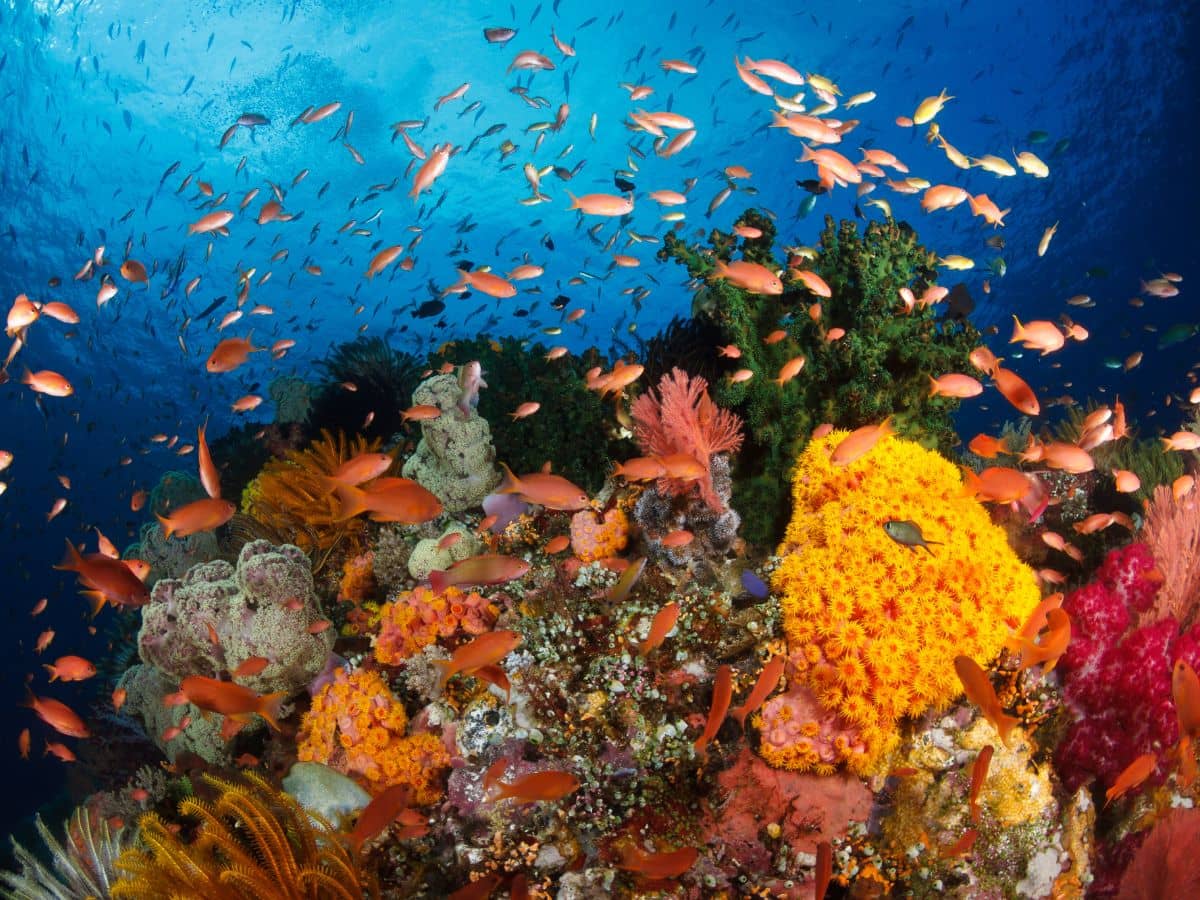
Ningaloo supports around 500 fish species and more than 200 species of coral, but the destination is known for the large animals that use the deep water just outside the reef. Three of them are seasonal and one, the manta, is here all year.
Big animals
- Whale sharks from mid-March to the end of July, encountered by snorkel on licensed tours off Tantabiddi.
- Humpback whales from June to November on migration, with licensed in-water swims from August to October.
- Reef manta rays year round at the Bateman Bay cleaning stations off Coral Bay, most numerous May to November.
- Orcas seen offshore in the humpback months, occasionally hunting calves; sightings are from the boat, not in the water.
- Dugongs in the seagrass of Exmouth Gulf and the inner lagoon, usually seen from the surface.
Sharks and rays
- Grey nurse sharks at Navy Pier and Lighthouse Bay, most reliably from June to October.
- Wobbegongs and tawny nurse sharks resting under ledges and pier pilings.
- Whitetip and blacktip reef sharks on the outer reef and around the Muiron Islands.
- Spotted eagle rays, shovelnose rays and stingrays on the sand and in the gulf.
Reef and macro
- Green, loggerhead and hawksbill turtles, with nesting on the Jurabi and Bundegi beaches from November to February.
- Potato cod and large gropers under the pier and around the Muiron bommies.
- Nudibranchs, scorpionfish, frogfish and cleaner shrimp on the pier pilings, which are effectively an artificial macro site.
- Mass coral spawning in March, seven to ten nights after the full moon, which starts the whole season.
Dive conditions
Water temperature swings more than most tropical destinations: 27 to 29C from January to March, dropping to 21 to 23C from August to October. A 3 mm suit is fine in summer, but from June to October most divers want 5 mm, and a hood or vest is welcome on the cooler mornings and on the whale shark boats where you spend hours wet.
Visibility is typically 10 to 25 m and is honestly variable. The inner lagoon and gulf sites are the murkiest, the Muiron Islands and the outer reef are the clearest, and the March coral spawn cuts visibility for a week or two while it feeds the whale sharks. Wind is the main operational constraint: the cape blows most afternoons and the exposed Lighthouse Bay and Muiron sites are morning dives when the forecast allows.
Most diving is easy. Depths are 5 to 22 m, currents are usually light except at Navy Pier, which is dived at slack water only, and boat rides are 15 to 60 minutes. Open Water is enough for the standard sites, and there is no logged-dive minimum for most of them. Whale shark and humpback interactions are snorkel activities open to anyone who can swim, with no certification needed. Nitrox is available in Exmouth. The nearest recompression chamber is a long way off, so dive insurance covering evacuation matters here even though the diving is straightforward.
Ningaloo Reef through the year
Water and air temperature, visibility and rainfall for every month, with the windows we would book ourselves. Hover or tap a month for the detail.
- Water
- Air
- Visibility
- Rain
Show the monthly data as a table
| Month | Water °C | Air °C | Visibility | Rain | Diving | Notes |
|---|---|---|---|---|---|---|
| Jan | 27–29 °C | 25–37 °C | 10–20 m | 20 mm | Possible | Cyclone risk; very hot, few boats |
| Feb | 28–29 °C | 25–37 °C | 10–20 m | 45 mm | Possible | Cyclone season peak; hot and humid |
| Mar | 27–29 °C | 24–36 °C | 10–20 m | 40 mm | Good | Coral spawn; first whale sharks |
| Apr | 26–28 °C | 21–33 °C | 15–25 m | 20 mm | Peak | Whale shark season in full swing |
| May | 25–27 °C | 17–29 °C | 15–25 m | 35 mm | Peak | Whale sharks; calm mornings |
| Jun | 23–25 °C | 14–25 °C | 15–25 m | 45 mm | Peak | Whale sharks; cooler, light winds |
| Jul | 22–24 °C | 12–24 °C | 15–25 m | 20 mm | Peak | Peak whale sharks; first humpbacks |
| Aug | 21–23 °C | 13–26 °C | 15–30 m | 8 mm | Peak | Whale sharks end; humpback swims |
| Sep | 21–23 °C | 15–29 °C | 15–30 m | 3 mm | Peak | Humpback peak; coldest water |
| Oct | 22–24 °C | 18–32 °C | 15–25 m | 2 mm | Good | Last humpbacks; mantas at Coral Bay |
| Nov | 24–26 °C | 21–34 °C | 10–25 m | 3 mm | Good | Windy afternoons; turtles nesting |
| Dec | 26–28 °C | 24–36 °C | 10–20 m | 8 mm | Possible | Hot, windy; cyclone season opens |
Best time to visit Ningaloo Reef
Ningaloo is a southern hemisphere destination, so the seasons are inverted: summer runs December to February and winter June to August. The dive season is built around animals rather than weather, and the peak months are the cool, dry ones.
- March to July: whale shark season. It opens with the March coral spawn and runs to the end of July, peaking from April to June when the seas are settling and the water is still warm. This is the busiest and most expensive period, and tours book out.
- August to October: humpback season. Whale sharks taper off, licensed in-water humpback swims start in August and run to October, and the water is at its coldest at 21 to 23C. September is the quietest, clearest month for diving.
- November to February: the hot season, with air temperatures over 35C, afternoon wind and cyclone risk from November to April. Turtles nest from November and hatch from January, and prices and crowds are lower, but big-animal tours are not running.
- Cyclone risk: the Western Australian cyclone season runs November to April and peaks January to March. Cyclones are infrequent but they close the town and the boats for days when they come.
Getting to Ningaloo Reef
The gateway is Learmonth Airport (LEA), 36 km south of Exmouth, served by daily flights from Perth (PER) of about two hours. Perth has direct international flights from Singapore, Kuala Lumpur, Doha, Dubai, London and the main Australian cities, so most itineraries are a long-haul into Perth then a domestic connection. Coral Bay is 150 km south of Exmouth by road, around 90 minutes, and can also be reached from Carnarvon Airport (CVQ) about 230 km to the south, though flight options there are limited.
Transfers from Learmonth to Exmouth take 35 to 40 minutes and are run as a shuttle timed to the flights, or you can hire a car at the airport. A car is genuinely useful: Cape Range National Park, the Tantabiddi and Bundegi boat ramps, the turtle beaches and the shore snorkel entries are all spread along the peninsula and there is no public transport.
Driving from Perth is a long option at roughly 1,250 km and 13 to 14 hours, usually split over two days, and is only worth it as part of a wider Western Australia road trip.
Australia requires an electronic visa for almost all visitors. Most European passports use the eVisitor, and the United States, Canada, Japan and several others use the Electronic Travel Authority. Both are applied for online before departure; only New Zealand citizens are exempt.
Getting to Ningaloo Reef, and what to know before you go
Shuttle or hire car, 35 to 40 min north to Exmouth and the boat ramps
Daily 2-hour domestic flights to Learmonth; 13 to 14 hours by road
About 230 km by road to Coral Bay; limited flight schedule
Tantabiddi boat ramp (Exmouth) · Bundegi boat ramp (Exmouth) · Exmouth Boat Harbour · Coral Bay
- Best season
- Apr–Jul (whale sharks), Aug–Oct (humpbacks)
- Off season
- Nov–Feb (hot, windy, cyclone risk; big-animal tours not running)
- Typical trip
- 5–7 days on day boats; 10 to combine Exmouth and Coral Bay
- Experience
- OW, about 0 logged dives
- Park / marine fee
- Cape Range National Park day entry around AUD 17 per vehicle; licensed whale shark and humpback tours include a state interaction levy of roughly AUD 15–25 per person. Diving the marine park itself is free
- Visa
- eVisitor or Electronic Travel Authority required in advance for almost all visitors; New Zealand exempt
- Nitrox
- Available from Exmouth dive shops at extra cost
- Currency
- Australian dollar (AUD); cards accepted everywhere
- Language
- English
- Time zone
- UTC+8 (AWST), no daylight saving
- Power
- Type I, 230 V
- Whale shark
- Humpback whale
- Reef manta ray
- Grey nurse shark
- Wobbegong
- Tawny nurse shark
- Green turtle
- Dugong
| Species | Months | Where |
|---|---|---|
| Whale shark | Mid-Mar–Jul | Outer reef off Tantabiddi, licensed snorkel tours with spotter planes |
| Humpback whale | Aug–Oct | Outside the reef off Exmouth; licensed in-water swims |
| Reef manta ray | Year-round, peak May–Nov | Bateman Bay cleaning stations north of Coral Bay |
| Grey nurse shark | Jun–Oct | Navy Pier and the Lighthouse Bay ledges |
| Mass coral spawning | Mar, 7–10 nights after the full moon | Lagoon and reef flats along the whole reef |
| Nesting turtles and hatchlings | Nov–Feb nesting, Jan–Mar hatchlings | Jurabi and Bundegi beaches on the cape |
Seasons are typical, not guaranteed: sightings depend on currents, weather and luck.
Practical information
Park fees: Cape Range National Park charges a day entry fee per vehicle, around AUD 17, with holiday and annual passes available from the Department of Biodiversity, Conservation and Attractions. Diving the Ningaloo Marine Park itself is free, but licensed whale shark and humpback tours include a state interaction levy of roughly AUD 15 to 25 per person in the ticket price. Confirm current amounts with your operator.
Rules: whale shark and humpback interactions are licensed activities with legally set minimum distances, group sizes and no-touch rules, and they are snorkel only. Turtle nesting beaches are closed or restricted at night in season. No collecting anywhere in the marine park.
Money: Australian dollars, cards accepted everywhere including the boats. Exmouth and Coral Bay are remote towns and prices reflect that.
Diving: nitrox is available in Exmouth at extra cost. Navy Pier requires a booking with the single licensed operator and photo identification for defence clearance, and it can be cancelled at short notice for operational reasons.
Practicalities: 230 V with type I sockets, English, and time zone UTC+8 with no daylight saving. Exmouth and Coral Bay are small: book accommodation, hire cars and whale shark tours well ahead for the April to July peak.
Tips & recommendations
- Book whale shark tours months ahead: April to July sells out, and a cancelled day due to weather is easier to absorb if you have several days in town.
- Give yourself three or four days: the cape is windy and the exposed sites at Lighthouse Bay and the Muirons only run on the calm mornings.
- Reserve Navy Pier early and bring photo ID: access is limited, tide-dependent and subject to defence clearance.
- Hire a car: the boat ramps, the national park and the shore entries are spread over 40 km with no public transport.
- Bring 5 mm from June to October: the water drops to 21 to 23C and the whale shark and whale tours mean hours in and out of the water.
- Do not expect Great Barrier Reef visibility: 10 to 25 m is normal and the March spawn drops it further, which is exactly why the whale sharks turn up.
- Check the cyclone forecast for November to April: systems are rare but they shut the town down completely when they arrive.