Introduction to diving the Maldives
The Maldives is a chain of 26 natural atolls strung across roughly 870 km of the Indian Ocean, southwest of India and Sri Lanka. Almost all of it is water: fewer than 200 of the 1,190 islands are inhabited, and the highest natural point in the country is under three meters. For divers that geography matters more than any resort brochure, because the atolls act as giant sieves. Ocean water pushes through the channels on every tide, carries plankton onto the reef, and the plankton brings the animals people travel here to see.
There are three ways to dive the country. Resort diving gives you a house reef and daily boat dives inside one atoll. Local-island guesthouses offer the same at a lower price. Liveaboards, locally called safari boats, move between atolls and are the only realistic way to dive the outer channels of several atolls in one trip. The classic seven-night Central Atolls route covers North and South Malé, Ari, Vaavu and sometimes Rasdhoo, which is where most of the well-known sites are. Deep South routes (Laamu, Huvadhoo, Fuvahmulah, Addu) and Far North routes (Baa, Raa, Noonu, Lhaviyani, up to Haa Alif) run seasonally and suit divers who are comfortable in current.
Reef shapes you will hear about
Maldivian guides use a few local terms constantly. A thila is a submerged pinnacle inside an atoll, usually topping out between 8 and 15 m, ideal for a whole dive circling one structure. A kandu is a channel through the atoll rim, dived on the incoming tide for sharks and eagle rays holding in the flow. A giri is a small reef that reaches the surface, and a faru is a ring reef. Once you know which shape you are diving, the briefing makes far more sense.
Diving here is regulated: recreational dives are limited to 30 m and no-decompression profiles, and every dive is guided. Nitrox is standard on most liveaboards, often included in the price, which helps when you are doing three or four dives a day on repetitive profiles around 25 m.
Why dive the Maldives
Plenty of destinations have healthy reefs. What sets the Maldives apart is how reliably big animals show up once you understand the monsoon, combined with simple logistics from a single international airport.
- Mantas on schedule: reef mantas visit cleaning stations year-round, and feeding aggregations follow the plankton from one side of the atolls to the other with the monsoon. Hanifaru Bay in Baa Atoll can gather more than a hundred animals at once between June and November.
- Whale sharks without a chase: South Ari Atoll hosts juvenile whale sharks all year round, one of the few places in the world where sightings do not depend on a season.
- Channel diving: grey reef sharks, whitetips, eagle rays and tuna stack up in the kandus on incoming tides. Hook in, watch, and let the current do the work.
- Warm, clear water: 27 to 30 C all year and visibility that often exceeds 30 m during the northeast monsoon.
- Routes for every level: the central atolls suit newer divers; the Deep South and Far North add tiger sharks, hammerheads and stronger currents for those who want them.
- Straightforward travel: a free 30-day visa on arrival for all nationalities, and most liveaboards collect you at Malé airport within sight of the runway.
Dive sites in the Maldives
The sites below are grouped by the route they belong to. Central Atolls boats will dive most of the first five in a week; Kuredu Express is a Far North stop, and Hanifaru is a snorkel-only bay that many Baa Atoll trips include in season.
Maaya Thila (North Ari Atoll)
A compact pinnacle about 80 m across, protected as a marine area, with a top at 6 m and overhangs down to 30 m. Whitetip reef sharks patrol the ledges, and it is the standard Maldives night dive: sharks, giant trevally and moray eels hunting in torch light.
Fish Head, Mushimasmingili Thila (North Ari Atoll)
Once a shark-feeding site, now a protected thila where grey reef sharks still gather on their own. Schools of blue-striped snapper, batfish and large Napoleon wrasse crowd the terraces between 10 and 25 m. Currents can be strong on the up-current side.
Manta Point, Lankan (North Malé Atoll)
A cleaning station on the eastern edge of the atoll where reef mantas queue over coral blocks at 12 to 18 m to be cleaned by wrasse. Most reliable from May to November, when the southwest monsoon pushes plankton to this side. Settle on the sand patch, stay still, and the mantas come to you.
Kandooma Thila (South Malé Atoll)
A teardrop-shaped pinnacle in the mouth of a channel, dived on the incoming current. Grey reef sharks, eagle rays, dogtooth tuna and jacks hang off the point, and the reef itself is thick with soft coral. One of the more demanding central sites because of the current.
Fotteyo Kandu (Vaavu Atoll)
Regularly named among the best channel dives in the country. A narrow kandu with caves, swim-throughs and yellow soft coral, where grey reef sharks, occasional hammerheads and huge schools of fusiliers ride the incoming flow. Hook in at the corner around 25 to 30 m.
Kuredu Express (Lhaviyani Atoll)
The name is honest. This channel on the eastern side of Lhaviyani runs fast on the incoming tide, and divers drift past grey reef sharks, eagle rays and turtles. Lhaviyani is also home to one of the largest green turtle populations in the Maldives.
Hanifaru Bay (Baa Atoll, snorkel only)
A core zone of the Baa Atoll UNESCO Biosphere Reserve where plankton traps in a small bay during the southwest monsoon. Between June and November, feeding chains of dozens to more than a hundred mantas, plus whale sharks, gather here. Scuba has been banned since 2011; visits are ranger-controlled snorkel sessions with limits on numbers and time in the water.
Marine life in the Maldives
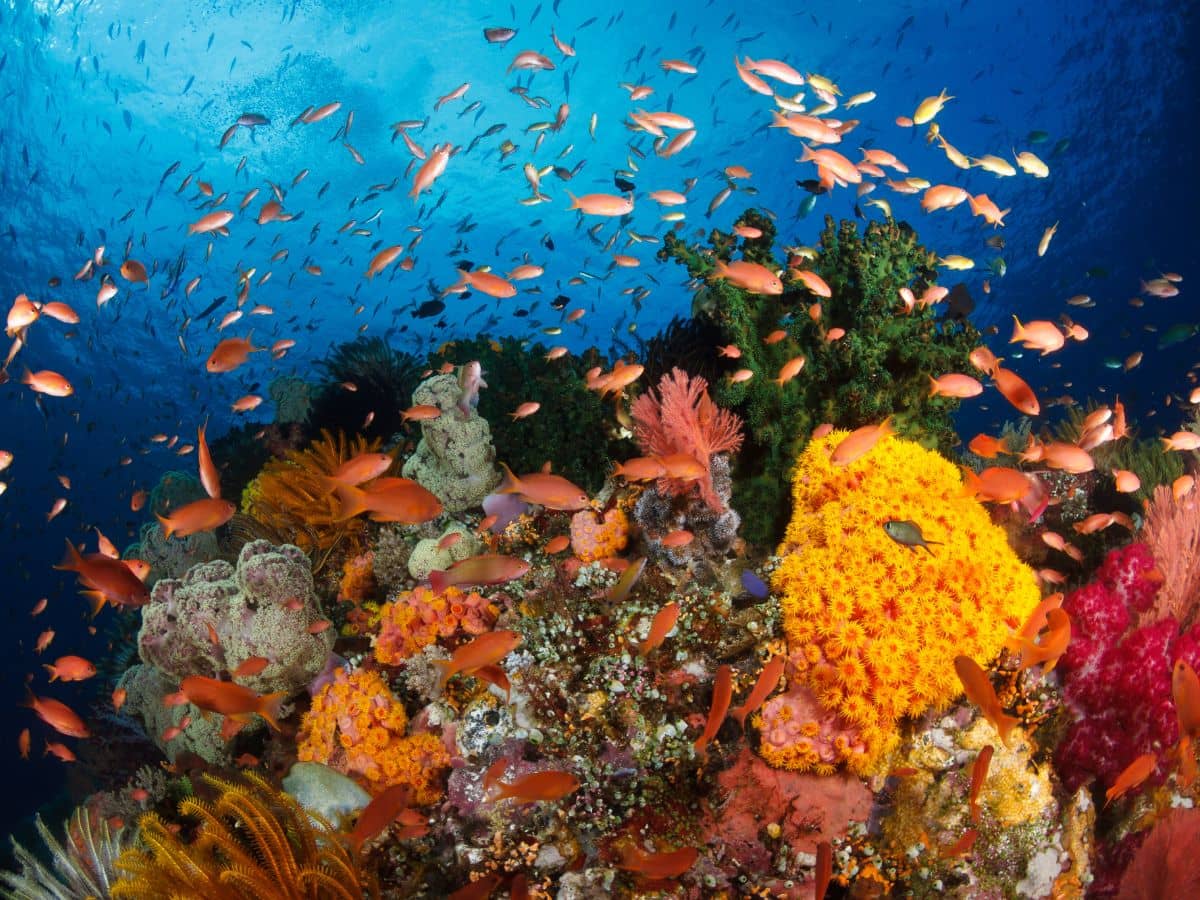
Big animals are the draw, but the fish biomass on Maldivian reefs is remarkable in its own right, especially on the thilas, where schooling fish surround you from the first minute of the dive and the sharks are simply part of the background.
Pelagics and big animals
- Reef mantas year-round at cleaning stations; oceanic mantas occasionally in the Deep South
- Whale sharks, resident off South Ari and seasonal at Hanifaru Bay and Fuvahmulah
- Grey reef, whitetip and blacktip sharks in every channel; scalloped hammerheads at Rasdhoo and in the south; tiger sharks at Fuvahmulah
- Spotted eagle rays, dogtooth tuna, giant trevally, barracuda and rainbow runners
- Green and hawksbill turtles, common in Lhaviyani and Baa
Reef
- Napoleon wrasse, bumphead parrotfish and oriental sweetlips in dense schools
- Fusiliers, blue-striped snapper, batfish and bannerfish clouding the thilas
- Soft coral and sea fans in the channels; hard coral recovering steadily since the 2016 bleaching
Macro
- Leaf scorpionfish, frogfish and ghost pipefish for divers who look closely
- Nudibranchs, cleaner shrimp and mantis shrimp on the overhangs
- Moray eels of several species, often out hunting on night dives
Dive conditions in the Maldives
Conditions here are set by tide and monsoon more than by weather. Water temperature stays between 27 and 30 C all year, so a 3 mm shorty or full suit is enough for most people; bring a 5 mm if you get cold on four dives a day, and a rash guard for the sun on the dive dhoni between dives.
Visibility runs 20 to 50 m during the northeast monsoon (December to April) and drops to around 15 to 25 m in the southwest monsoon, when plankton-rich water arrives with the mantas. Currents in the channels range from gentle to very strong, and this is what the Maldives asks of you: comfort with negative entries, hooking in with a reef hook, and drifting without a fixed reference. Inside the atolls, thila dives are far calmer.
Depth is capped at 30 m by Maldivian regulation and dives are no-decompression only. Open Water divers with around 20 logged dives are welcome on Central Atolls routes; Deep South and Far North itineraries usually ask for Advanced Open Water and 50 or more dives. Nitrox is widely available and worth using on repetitive profiles.
Maldives through the year
Water and air temperature, visibility and rainfall for every month, with the windows we would book ourselves. Hover or tap a month for the detail.
- Water
- Air
- Visibility
- Rain
Show the monthly data as a table
| Month | Water °C | Air °C | Visibility | Rain | Diving | Notes |
|---|---|---|---|---|---|---|
| Jan | 27–29 °C | 25–30 °C | 25–40 m | 75 mm | Peak | Dry season, sharks in the eastern channels |
| Feb | 28–29 °C | 25–31 °C | 25–45 m | 50 mm | Peak | Clearest water of the year |
| Mar | 28–30 °C | 26–31 °C | 25–45 m | 75 mm | Peak | Deep South and Fuvahmulah trips run |
| Apr | 29–30 °C | 26–32 °C | 20–35 m | 130 mm | Peak | Warmest water, monsoon turning |
| May | 28–30 °C | 26–31 °C | 15–25 m | 215 mm | Good | Southwest monsoon starts, mantas move east |
| Jun | 28–29 °C | 26–30 °C | 15–25 m | 170 mm | Good | Hanifaru Bay manta season opens |
| Jul | 27–29 °C | 25–30 °C | 15–25 m | 150 mm | Good | Manta aggregations, choppier crossings |
| Aug | 27–28 °C | 25–30 °C | 15–25 m | 175 mm | Good | Peak Hanifaru, whale sharks on the east |
| Sep | 27–28 °C | 25–30 °C | 15–25 m | 200 mm | Good | Hanifaru continues, Deep South resumes |
| Oct | 28–29 °C | 25–30 °C | 15–25 m | 220 mm | Good | Wettest month, mantas still on the east |
| Nov | 28–29 °C | 25–30 °C | 15–30 m | 200 mm | Good | End of manta aggregations |
| Dec | 28–29 °C | 25–30 °C | 20–35 m | 230 mm | Good | Monsoon switch, seas can be unsettled |
Best time to visit Maldives
The Maldives dives all year, but the two monsoons decide what you see and where. There is no wrong month, only wrong routes for a given month.
- January to April (northeast monsoon, Iruvai): the dry season. Flat seas, visibility at its best, and currents flowing into the atolls from the east, which lines the eastern channels with sharks and eagle rays. Mantas feed on the western side of the atolls. Peak demand and peak prices; book well ahead.
- May to November (southwest monsoon, Hulhangu): wetter, with short heavy showers and choppier crossings, but plankton pushes to the eastern side, so mantas gather at Lankan and at Hanifaru Bay, where June to October is prime. Visibility is lower and prices soften.
- December: the switch-over month, often with unsettled seas for a week or two before the dry season settles in.
- Whale sharks: South Ari is reliable all year; sightings shift to the west side of the atoll in the northeast monsoon and to the east in the southwest monsoon.
- Deep South and Fuvahmulah: generally run from about February to April and again from September to November, when the crossings are calmer.
Getting to the Maldives
Every international traveler lands at Velana International Airport (MLE) on Hulhulé island, a ten-minute ferry or speedboat from the capital, Malé. Direct flights arrive from Dubai, Doha, Abu Dhabi, Istanbul, Singapore, Kuala Lumpur, Colombo, Mumbai and Delhi, and seasonally from several European cities including London, Frankfurt, Milan and Paris. Most itineraries from Europe or North America connect once in the Gulf or Southeast Asia.
Central Atolls liveaboards embark at Hulhumalé or in the airport lagoon, usually within an hour or two of your arrival, so no hotel night is needed at either end. Boats ask for your arrival flight number and meet you in the terminal.
Far North and Deep South routes often start with a domestic flight: Dharavandhoo (DRV) for Baa Atoll, Hanimaadhoo (HAQ) for the far north, Kooddoo (GKK) or Kaadedhdhoo (KDM) for Huvadhoo, and Gan (GAN) on Addu for the Deep South and Fuvahmulah. Maldivian and FlyMe operate these routes with baggage allowances tighter than on international flights; check the dive-gear allowance before you pack.
All nationalities receive a free 30-day tourist visa on arrival, provided the online Imuga traveler declaration is completed within 96 hours before arrival and you can show an onward ticket and a confirmed accommodation or boat booking. Passports should have at least six months of validity.
Getting to Maldives, and what to know before you go
Central Atolls liveaboards embark in the airport lagoon or at Hulhumalé, 10 to 20 min by boat
Domestic flight from MLE, approximately 90 min; Deep South and Fuvahmulah boats embark at Gan
Domestic flight from MLE, approximately 25 min; Baa and Far North boats embark nearby
Domestic flight from MLE, approximately 55 min; Far North route embarkation
Direct flight to MLE, approximately 4 h 30
Direct flight to MLE, approximately 4 h 45
Direct flight to MLE, approximately 4 h 30
Malé / Hulhumalé · Gan (Addu) · Dharavandhoo (Baa) · Hanimaadhoo
- Best season
- Jan–Apr
- Off season
- May–Nov (southwest monsoon: rougher crossings, lower visibility, but manta aggregations)
- Typical trip
- 7 nights (10 nights for Deep South and Far North)
- Experience
- OW, about 20 logged dives
- Park / marine fee
- Green Tax approximately USD 12 per person per night on liveaboards and resorts; Hanifaru Bay snorkel permit approximately USD 20 per visit
- Visa
- Free 30-day visa on arrival for all nationalities; online Imuga declaration within 96 h before arrival
- Nitrox
- Available on nearly all liveaboards, often free
- Currency
- Maldivian rufiyaa (MVR); US dollars accepted throughout tourism
- Language
- Dhivehi; English spoken throughout the dive industry
- Time zone
- UTC+5
- Power
- Type G (UK three-pin), 230 V; some resorts also fit type D or C
- Reef manta ray
- Whale shark
- Grey reef shark
- Whitetip reef shark
- Spotted eagle ray
- Green turtle
- Napoleon wrasse
- Tiger shark
| Species | Months | Where |
|---|---|---|
| Reef manta ray | May–Nov | Hanifaru Bay, Lankan Manta Point (eastern sides) |
| Reef manta ray | Dec–Apr | Western sides of Ari and the central atolls |
| Whale shark | Year-round | South Ari Atoll; Hanifaru Bay Jun–Nov |
| Grey reef shark | Jan–Apr | Eastern channels on incoming tide |
| Scalloped hammerhead | Jan–Apr | Rasdhoo Madivaru, Fotteyo Kandu, Deep South |
| Tiger shark | Feb–Apr, Sep–Nov | Fuvahmulah |
Seasons are typical, not guaranteed: sightings depend on currents, weather and luck.
Practical information
The Maldives charges a Green Tax per person per night on resorts, hotels and tourist vessels including liveaboards, doubled from USD 6 to approximately USD 12 in January 2025; guesthouses pay half that. Tourism goods and services tax (TGST) is approximately 17 percent. Some operators quote these inside the trip price and others add them at checkout, so ask before comparing quotes. Marine protected areas charge no separate dive fee, but ranger-controlled Hanifaru Bay snorkel visits cost approximately USD 20 per person per session.
The currency is the Maldivian rufiyaa (MVR), but US dollars are accepted almost everywhere in tourism and cards are common on liveaboards, sometimes with a surcharge. Crew tips are customary, usually pooled at the end of the trip. Plugs are the UK three-pin type G at 230 V; the language is Dhivehi, with English spoken throughout the dive industry. Dive insurance is expected, and recompression chambers operate at Bandos (North Malé) and Kuramathi (Rasdhoo). Nitrox is available on nearly all liveaboards, frequently free of charge.
Tips & recommendations
- Pick the month before the boat: decide whether you want dry-season visibility and shark channels (January to April) or manta aggregations (June to November), then choose a route that matches.
- Bring your own reef hook: channel dives are far more relaxed hooked in at the edge than finning against the current. Boats lend them, but a hook you have used before is better.
- Pack a torch and a spare: Maaya Thila at night is one of the reasons to come, and a primary plus backup light is expected.
- Check what the quote includes: Green Tax, TGST, nitrox, marine area fees and airport transfers vary from operator to operator and change the real price by several hundred dollars.
- Follow manta etiquette: stay low at cleaning stations, keep still, never approach from the front or above, and let the animal choose the distance. Guides enforce the Manta Trust code of conduct.
- Mind the domestic baggage limit: Deep South and Far North trips usually start with a small aircraft; dive bags over the allowance are charged or left behind.
- Leave a full day before flying home: most boats finish diving the afternoon before disembarkation, but check your own last dive against your flight time.