Introduction to diving Belize
Belize sits on the Caribbean coast of Central America, with the Belize Barrier Reef running roughly 300 km along its length as the largest section of the Mesoamerican Barrier Reef System. Outside the barrier, in deep water, lie three coral atolls: Turneffe, the largest, about 40 km east of Belize City; Lighthouse Reef, further out and home to the Great Blue Hole and Half Moon Caye; and Glover\'s Reef to the south. The barrier reef and its cayes and atolls were inscribed as a UNESCO World Heritage Site in 1996.
The diving divides cleanly. Inside the barrier, off Ambergris Caye and Caye Caulker, are shallow reserves like Hol Chan and Shark Ray Alley, easy dives full of nurse sharks, rays and reef fish, reached in fifteen minutes from town. Outside, on the atoll rims, are the walls: coral spur-and-groove down to a lip at 12 to 20 m, then a vertical drop into blue water with sponges, gorgonians and big pelagics passing. The atoll walls are what serious divers come for and are largely a liveaboard or remote-lodge proposition.
The Blue Hole, in perspective
The Great Blue Hole is a 300 m wide, 124 m deep collapsed limestone cave in the middle of Lighthouse Reef, and the aerial photograph is one of the most reproduced images in diving. As a dive it is a deep, dark, short descent to about 40 m along a wall of stalactites, with almost no coral, very few fish and a bottom time measured in minutes. It is a geological curiosity and a box worth ticking, and it is worth knowing in advance that it is not scenically rich. The two dives that follow it, Half Moon Caye Wall and Long Caye Aquarium, are usually the better half of the day.
Practically, Belize is one of the easiest tropical destinations for English-speaking travelers: English is the official language, the Belize dollar is fixed at two to the United States dollar, and Belize City is a short flight from Houston, Miami, Dallas and Atlanta. That accessibility, plus a strong marine reserve system with real fees and rangers, is a large part of the country\'s appeal.
Why dive Belize
Belize offers Caribbean atoll wall diving with unusually simple logistics, and enough variety inside one country to fill a week without repeating a site.
- Three true atolls: Turneffe, Lighthouse Reef and Glover\'s Reef, three of only four coral atolls in the Caribbean, each with steep outer walls dropping into deep water.
- Half Moon Caye Wall: consistently rated among the best wall dives in the Caribbean, with garden eels on the sand shelf, a sharp drop-off and eagle rays and turtles along the edge.
- Shallow reserves that actually deliver: Hol Chan and Shark Ray Alley put nurse sharks, southern stingrays, tarpon and groupers in 5 to 10 m, fifteen minutes from Ambergris Caye.
- Whale sharks at Gladden Spit: from March to June around the full moon, whale sharks come in to feed on snapper spawn off Placencia, though sightings have become far less reliable than they once were.
- A Belize endemic: the whitespotted toadfish occurs only in Belizean waters and is a regular find under coral ledges for guides who know where to look.
- English-speaking, easy access: direct flights from several United States hubs, English as the official language, and the Belize dollar pegged two to one against the United States dollar.
Dive sites in Belize
Sites split between the inner barrier reserves near Ambergris Caye, reachable by day boat, and the atoll walls, which are a liveaboard trip or a stay at a remote caye lodge.
The Great Blue Hole
A near-circular limestone sinkhole 300 m across and 124 m deep in the middle of Lighthouse Reef. The dive descends the wall to around 40 m, where a shelf of huge stalactites, formed when the cave was dry during the last ice age, angles out over the void. Bottom time is roughly eight minutes, the water is dark and still, and there is little coral or fish life beyond the occasional reef shark in the blue. Advanced Open Water and good buoyancy are required; go for the geology and treat the two follow-up dives as the day\'s real diving.
Half Moon Caye Wall
The signature wall of Lighthouse Reef and the site most divers rate above the Blue Hole. A sand shelf at 12 m carries a colony of garden eels and coral heads, then the wall drops vertically past enormous barrel sponges and gorgonians. Eagle rays, turtles, Caribbean reef sharks and big groupers work the edge. The caye above is a national monument protecting a red-footed booby colony, worth the walk to the observation platform.
Long Caye Aquarium
Also on Lighthouse Reef, a spur-and-groove reef running to a drop-off at about 15 m, with excellent coral cover in the shallows and consistently high visibility. Schooling horse-eye jacks, permit, turtles and reef sharks. The name is fair: it is the fish-life dive of the atoll and the standard third dive of a Blue Hole day.
The Elbow, Turneffe Atoll
The southern tip of Turneffe, where currents converge and the wall drops away. The most current-swept dive on the atoll and the most reliable for schooling fish: big aggregations of horse-eye jacks and cubera snapper, eagle rays and, in season, spawning aggregations. A drift dive that needs settled weather and some experience.
Front Porch and Black Beauty, Turneffe
Two of the gentler Turneffe sites on the sheltered western side, in 12 to 25 m. Coral heads, swim-throughs and sponge-covered slopes, with green and spotted morays, spotted drums, seahorses on the gorgonians and the endemic whitespotted toadfish under the ledges. This is where Turneffe earns its reputation for macro alongside the walls.
Hol Chan Marine Reserve
A natural cut through the barrier reef off the southern tip of Ambergris Caye, protected since 1987 and one of the oldest reserves in the region. Depths of 5 to 10 m, a channel full of grunts, snapper, groupers and green morays, huge tarpon, and turtles on the seagrass. Easy diving, often busy, and a good first dive of a trip.
Shark Ray Alley
A shallow sand flat inside Hol Chan, 3 to 8 m, where fishermen historically cleaned their catch and nurse sharks and southern stingrays learned to gather. Dozens of animals come in close, often assisted by chum from the boats. It is a busy, managed encounter rather than a wild one, and it is usually run as a snorkel; treat it as an experience rather than a dive.
Gladden Spit
An elbow in the barrier reef off Placencia, in the south, where mutton and cubera snapper form spawning aggregations around the full moons from March to June. The spawn draws whale sharks, and the site is protected within the Gladden Spit and Silk Cayes Marine Reserve with its own fee and guide requirement. Whale shark sightings have declined markedly over the last decade, so book with expectations set accordingly.
Silver Caves, Glover\'s Reef
Glover\'s Reef is the least visited of the three atolls, reached by liveaboard or by a stay on one of its cayes. Silver Caves runs along the outer wall with a series of overhangs and cuts packed with silversides in season, plus reef sharks patrolling the drop-off. Visibility here is often the best in the country.
Marine life in Belize
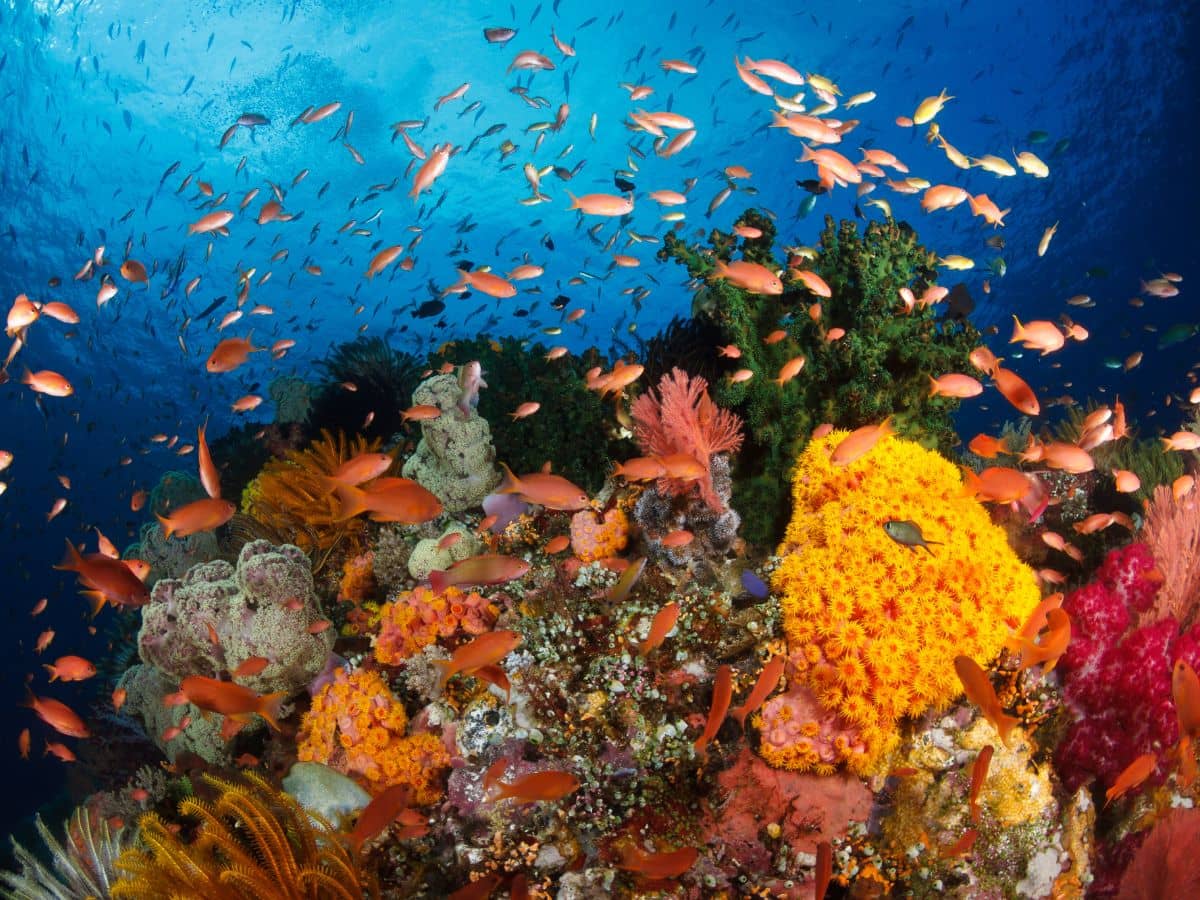
Belize holds a full Caribbean reef community, with around 500 fish species and 65 coral species recorded on the barrier and atolls, plus a marine mammal and megafauna list that includes manatee and whale shark.
Sharks and rays
- Nurse sharks, abundant and habituated at Shark Ray Alley and common under ledges everywhere else.
- Caribbean reef sharks along the atoll walls, most reliably at Half Moon Caye, the Elbow and Glover\'s Reef.
- Southern stingrays on the sand flats and spotted eagle rays cruising the drop-offs.
- Whale sharks at Gladden Spit around the full moons from March to June, now much less reliable than in the 2000s.
Reef fish and big fish
- Nassau grouper, black grouper and enormous jewfish-sized goliath grouper on the deeper walls.
- Spawning aggregations of mutton and cubera snapper at Gladden Spit and the Elbow.
- Schooling horse-eye jacks, permit, bar jacks and great barracuda in the channels and on the corners.
- Tarpon in numbers at Hol Chan, green and spotted morays throughout, and midnight and rainbow parrotfish on the reef flats.
Macro and specialties
- Whitespotted toadfish, endemic to Belize, under coral ledges on Turneffe and the inner reefs.
- Seahorses, spotted drums, arrow crabs, banded coral shrimp and yellowhead jawfish on the sheltered slopes.
- West Indian manatee in the seagrass and river mouths near Swallow Caye, a protected snorkel encounter rather than a dive.
- Hawksbill, green and loggerhead turtles, all three of which nest on Belizean cayes.
Dive conditions
Water temperature runs from about 26C in January and February to 30C in August and September. A 3 mm full suit covers the year for most divers; a shorty is enough in late summer, and a 5 mm is worth having if you dive four times a day in winter or feel the cold at 40 m in the Blue Hole, where the water is noticeably cooler and stiller than outside.
Visibility is typically 20 to 40 m on the atolls, often at the higher end at Lighthouse Reef and Glover\'s Reef, and lower, around 12 to 25 m, inside the barrier where sediment and river runoff reach. Heavy rain from June to October reduces inshore visibility more than atoll visibility.
Conditions are mostly easy. Hol Chan, Shark Ray Alley and the sheltered Turneffe sites suit Open Water divers. The atoll walls involve deep water below you and moderate current, and the Elbow can run hard enough to make it a genuine drift dive. The Blue Hole requires Advanced Open Water, and most operators want to see logged deep dives; nitrox is of limited use there because of the depth but is valuable across a repetitive atoll day. Winter cold fronts, locally called northers, bring wind from November to February and can keep boats off the outer atolls for a day or two.
Belize through the year
Water and air temperature, visibility and rainfall for every month, with the windows we would book ourselves. Hover or tap a month for the detail.
- Water
- Air
- Visibility
- Rain
Show the monthly data as a table
| Month | Water °C | Air °C | Visibility | Rain | Diving | Notes |
|---|---|---|---|---|---|---|
| Jan | 26–27 °C | 20–28 °C | 20–35 m | 140 mm | Good | Dry but northers cancel atoll days |
| Feb | 26–27 °C | 21–29 °C | 25–40 m | 65 mm | Good | Driest month; wind still a factor |
| Mar | 26–28 °C | 22–30 °C | 25–40 m | 40 mm | Peak | Season starts; Gladden Spit spawning |
| Apr | 27–28 °C | 23–31 °C | 25–40 m | 55 mm | Peak | Calm seas; whale shark full moons |
| May | 28–29 °C | 25–32 °C | 25–40 m | 110 mm | Peak | Best visibility; snapper aggregations |
| Jun | 29 °C | 25–31 °C | 20–35 m | 200 mm | Peak | Rains start; last whale shark moon |
| Jul | 29–30 °C | 24–31 °C | 20–35 m | 190 mm | Good | Hot and wet; diving still good |
| Aug | 29–30 °C | 24–31 °C | 20–35 m | 190 mm | Good | Warmest water; hurricane risk rising |
| Sep | 29–30 °C | 24–31 °C | 15–30 m | 250 mm | Possible | Hurricane season peak; some closures |
| Oct | 28–29 °C | 23–30 °C | 15–30 m | 300 mm | Possible | Wettest month; maintenance breaks |
| Nov | 28 °C | 22–29 °C | 20–35 m | 225 mm | Good | Rain easing; first northers late |
| Dec | 27–28 °C | 21–28 °C | 20–35 m | 185 mm | Good | Dry season opens; windy spells |
Best time to visit Belize
Belize dives year-round. The dry season from late November to May gives the calmest seas and clearest water, while the wet season from June to November brings heavy rain and the Atlantic hurricane risk. Whale sharks and snapper spawning add a specific spring window.
- March to June: the best overall period. Calm seas, water warming from 27 to 29C, high visibility on the atolls, and the Gladden Spit snapper spawning and whale shark window around each full moon.
- December to February: dry, pleasant on land and clear underwater, but this is norther season: cold fronts push wind through every week or two and can cancel outer atoll and Blue Hole days. Water around 26C.
- July and August: hot, humid, warm water at 29 to 30C and generally good diving, with afternoon rain. Hurricane risk exists but is lower than in the following two months.
- September and October: the wettest months and the peak of the Atlantic hurricane season. Some lodges and boats take their annual maintenance break; rates are lowest and disruption risk is highest.
- November: the transition. Rain easing, hurricane risk falling away, water still around 28C, and the first northers usually late in the month.
Getting to Belize
Philip S. W. Goldson International Airport (BZE) sits about 15 km northwest of Belize City and has direct flights from Houston, Dallas, Miami, Atlanta, Charlotte, Newark, Toronto and several other North American cities, plus regional connections through San Salvador and Panama City. European travelers normally connect through a United States hub or through Mexico.
From BZE, most divers do one of three things. Ambergris Caye is reached by a 15-minute domestic hop to San Pedro (SPR) or by a water taxi from Belize City, roughly 75 to 90 minutes. Liveaboards embark in Belize City, generally on Saturdays, and run seven-night itineraries covering Turneffe, Lighthouse Reef and often Glover\'s Reef. Remote lodges on Turneffe and Glover\'s arrange their own boat transfers, usually on a fixed weekly schedule, so your flights need to match their transfer day.
Placencia, the base for Gladden Spit whale shark trips, has its own airstrip (PLJ) served by domestic flights from BZE, or is around three hours by road. Belize City Municipal Airport (TZA) handles some domestic flights and is more convenient than BZE if you are already in the city.
Citizens of the United States, Canada, the United Kingdom, the European Union, Australia and most Commonwealth countries enter Belize visa-free for tourism, typically for up to 30 days, extendable locally. A departure tax and conservation fee apply on leaving, usually already included in the air ticket.
Getting to Belize, and what to know before you go
Liveaboards embark in Belize City, 20 to 30 min; domestic hops and water taxis to the cayes
15-min domestic flight from BZE, or 75 to 90 min by water taxi
Domestic flight from BZE, or about 3 h by road; base for Gladden Spit
In-city airstrip for domestic hops to the cayes and Placencia
Belize City · San Pedro (Ambergris Caye) · Placencia
- Best season
- Mar–Jun
- Off season
- Sep–Oct (peak Atlantic hurricane season, heaviest rain)
- Typical trip
- 7 nights (liveaboards run Saturday to Saturday)
- Experience
- Open Water (AOW for the Blue Hole), about 0 logged dives
- Park / marine fee
- Per-reserve fees: approximately USD 40 for the Blue Hole and Half Moon Caye Natural Monuments combined, around USD 10 for Hol Chan Marine Reserve, plus a separate daily fee for Gladden Spit and Silk Cayes; usually billed on top of the dive price
- Visa
- Visa-free for most Western nationalities, typically 30 days, extendable
- Nitrox
- Available on liveaboards and at most Ambergris Caye shops, usually at extra cost
- Currency
- Belize dollar (BZD), fixed at 2 to 1 against the US dollar; USD accepted everywhere
- Language
- English (official), plus Kriol and Spanish
- Time zone
- UTC-6 (CST, no daylight saving)
- Power
- Type A/B, 110–120 V
- Nurse shark
- Caribbean reef shark
- Southern stingray
- Spotted eagle ray
- Whale shark
- Whitespotted toadfish
- Nassau grouper
- Tarpon
| Species | Months | Where |
|---|---|---|
| Whale shark | Mar–Jun, around full moon | Gladden Spit, off Placencia, now unreliable |
| Cubera and mutton snapper spawning | Mar–Jun, around full moon | Gladden Spit and the Elbow, Turneffe |
| Caribbean reef shark | Year-round | Half Moon Caye Wall, Glover's Reef outer walls |
| Nurse shark and southern stingray | Year-round | Shark Ray Alley and Hol Chan Marine Reserve |
| Silverside shoals | Jun–Aug | Overhangs and cuts at Silver Caves, Glover's Reef |
| Nesting turtles | Jun–Sep | Half Moon Caye and the outer atoll cayes |
Seasons are typical, not guaranteed: sightings depend on currents, weather and luck.
Practical information
Reserve fees: Belize charges per-reserve entry fees rather than one national fee. Expect around USD 40 for the Blue Hole Natural Monument and Half Moon Caye Natural Monument combined, both managed by the Belize Audubon Society, roughly USD 10 for Hol Chan Marine Reserve, and a separate daily fee for Gladden Spit and Silk Cayes. Liveaboards usually bundle atoll fees into a single park charge; day operators bill them per trip.
Rules: no touching, no gloves at most operators, no collecting and no spearfishing inside reserves. Nassau grouper and other spawning aggregation sites carry seasonal closures. Whale shark encounters at Gladden Spit require a licensed guide and permit and are limited in numbers.
Money: the Belize dollar is fixed at BZD 2 to USD 1 and United States dollars are accepted everywhere. Cards work in San Pedro and Placencia but cash is needed on the remote cayes and for park fees and tips.
Diving: nitrox is available on liveaboards and at most Ambergris Caye shops. The Blue Hole requires Advanced Open Water and logged deep experience. There is a hyperbaric chamber in San Pedro on Ambergris Caye; dive insurance covering evacuation is strongly recommended given the distance to the atolls.
Practicalities: 110 to 120 V with type A, B and G sockets in places; English is the official language, with Kriol and Spanish widely spoken; Belize runs on UTC-6 year-round with no daylight saving.
Tips & recommendations
- Set expectations on the Blue Hole: it is a deep, dark, eight-minute look at stalactites with little life. Do it once, for the geology, and judge the day by Half Moon Caye Wall and Long Caye Aquarium.
- Get out to the atolls: the inner barrier reserves are pleasant but the wall diving at Lighthouse Reef, Turneffe and Glover\'s Reef is what makes Belize worth the flight.
- Match your flights to the transfer day: liveaboards and remote lodges run fixed weekly boat schedules; arriving a day late can cost you the whole week.
- Time a spring trip to the full moon: the Gladden Spit snapper spawning and whale shark window runs a few days either side of the full moons from March to June.
- Budget for reserve fees separately: Belize charges by reserve, and a week that includes the Blue Hole, Half Moon Caye, Hol Chan and Gladden Spit adds up.
- Expect a norther in winter: from November to February a cold front can shut the outer atolls for a day or two, so leave slack in a short trip.
- Ask for the toadfish: the whitespotted toadfish is a Belize endemic and a genuine tick, but only guides who work the same ledges will find it for you.