Introduction to diving the Bahamas
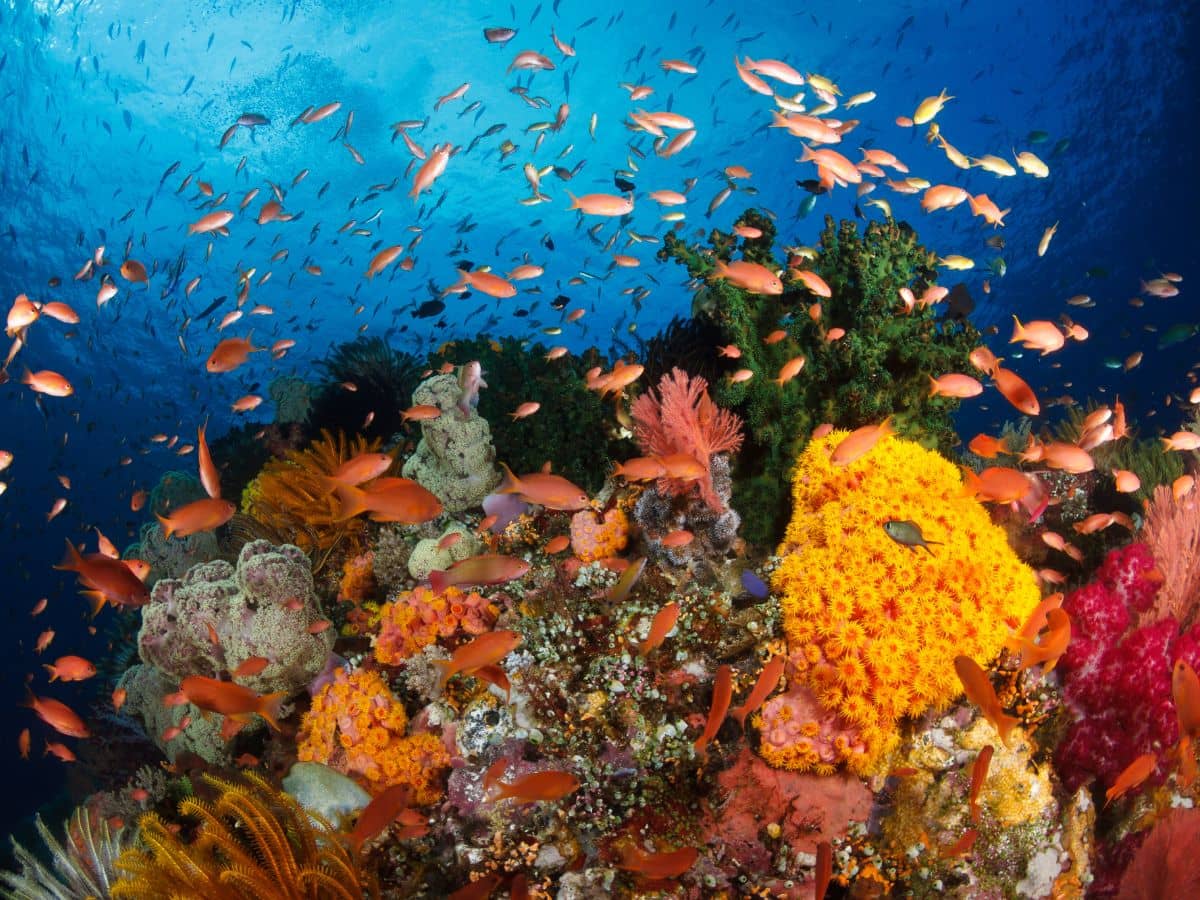
The Bahamas is a chain of roughly 700 islands and 2,000 cays spread over 800 km of shallow carbonate banks, starting less than 100 km off the Florida coast. That geography defines the diving: vast pale sand flats in a few meters of water, edged abruptly by drop-offs into channels thousands of meters deep. The clarity that follows from having almost no rivers and no runoff is why the water here photographs the way it does.
In 2011 the country declared its entire exclusive economic zone a shark sanctuary, banning commercial shark fishing and the sale of shark products. That decision, together with two decades of operator-run feeding, is why shark populations here are dense and habituated. The three encounters the Bahamas is known for, tiger sharks at Tiger Beach, great hammerheads at Bimini and Caribbean reef sharks at Nassau and Freeport, are all provisioned dives, run with a crate or a feeder in a chainmail suit. They are extraordinary, and they are managed encounters rather than wild ones; going in clear about that matters.
Islands, not one destination
There is no single base that covers the country. Grand Bahama and West End are the jumping-off point for Tiger Beach; Bimini, the closest island to Florida, is where great hammerheads gather in winter; New Providence and Nassau offer wrecks, walls and a long-running reef shark dive; the Exumas hold quiet reefs, wrecks and cave systems; Andros sits on the edge of the Tongue of the Ocean and has the country\'s blue holes; Abaco and Marsh Harbour give reefs and wrecks in the north.
Most shark-focused trips are liveaboards sailing from Palm Beach or Fort Lauderdale in Florida, or from Freeport, on itineraries of five to eight nights built around Tiger Beach and Bimini. Land-based diving is straightforward on New Providence, Grand Bahama and the larger Out Islands, and combines resort comfort with day-boat access to walls and wrecks.
Why dive the Bahamas
Few destinations put this many large sharks in this little water this close to a major airport, and the supporting cast of walls, wrecks and blue holes is stronger than the shark headlines suggest.
- Tiger Beach: a sand flat in 5 to 8 m off West End where tiger sharks, lemon sharks and nurse sharks gather around a bait crate, in bright light and 30 m visibility. The most reliable tiger shark diving anywhere.
- Great hammerheads at Bimini: from December to March, great hammerheads come onto the shallow banks off South Bimini, again over white sand at 6 to 12 m, giving the clearest images of the species in the world.
- A national shark sanctuary: commercial shark fishing has been banned across the entire Bahamian EEZ since 2011, which is a direct reason the populations remain what they are.
- The Tongue of the Ocean: a 2,000 m deep trench cutting into the banks, giving sheer wall dives off Andros and New Providence that start at 15 m and fall away out of sight.
- Wrecks with history and film credits: Theo\'s Wreck off Freeport, the Ray of Hope off Nassau, and the James Bond film wrecks on New Providence.
- Blue holes and caves: Andros has the highest concentration of blue holes in the world, and Mystery Cave at Staniel Cay in the Exumas is a genuine cavern dive.
Dive sites in the Bahamas
Sites are grouped by island rather than by a single itinerary. Shark liveaboards work Tiger Beach and Bimini; land-based diving centers on New Providence, Grand Bahama, the Exumas and Abaco.
Tiger Beach, Grand Bahama
A shallow sand flat about 30 km off West End, in only 5 to 8 m of water. Operators anchor, put down a bait crate and kneel divers on the sand while tiger sharks, large lemon sharks, nurse sharks and Caribbean reef sharks circle. Visibility is usually 25 to 30 m and the light is exceptional. This is an entirely baited encounter with a strict briefing: stay on the bottom, keep your back to nothing, and follow the safety divers. Best from October to January, when tigers are most numerous.
Bimini great hammerhead grounds
Shallow sand flats off South Bimini where great hammerheads, some over four meters, come in to a bait box from roughly December to March. Depths of 6 to 12 m, white sand, and animals that pass within arm\'s length. Bull sharks and nurse sharks share the site. The season is short and weather-dependent, and cold fronts can shut it down for days.
Theo\'s Wreck, Grand Bahama
A 70 m cement freighter deliberately sunk off Freeport in 1982, lying on its port side on the edge of a wall in 30 m. Well-broken-in, with penetration through the holds, big groupers and morays inside, and eagle rays and reef sharks on the drop-off alongside. The best wreck dive on Grand Bahama.
Shark Junction, Grand Bahama
A 15 m reef site off Freeport where Caribbean reef sharks have been fed for decades, with dozens of animals turning up on schedule alongside groupers, moray eels and nurse sharks. Shallow, easy and heavily managed, and a good introduction to shark diving for anyone building up to Tiger Beach.
Shark Arena and Runway Wall, New Providence
Off the south coast of New Providence, a sand arena at about 12 m where Caribbean reef sharks are fed by a diver in chainmail, paired with the adjacent Runway Wall, which drops from 15 m into the Tongue of the Ocean. The wall gives the depth and the pelagic chance; the arena gives the shark count.
Ray of Hope, New Providence
A 60 m freighter sunk off Nassau in 2003 as an artificial reef, sitting upright in about 25 m with the mast reaching up to 15 m. Reef sharks patrol it constantly because of the nearby feeding sites, and the holds are open enough for straightforward penetration. Often combined with the Bond wrecks nearby.
Austin Smith Wreck, Exuma
A former Bahamian defence force cutter that sank under tow and now lies on its side in 18 m off Exuma. Compact, easy and encrusted, with schooling grunts and snapper, nurse sharks under the hull and turtles passing. A relaxed dive in an area otherwise known for its shallow reefs.
Mystery Cave, Staniel Cay
A cavern system running under Staniel Cay in the Exumas, entered from around 12 m and continuing back into the rock. Silversides fill the entrance in summer, tarpon hunt them, and the light shafts through the openings make it one of the more atmospheric dives in the country. Cavern rules apply and a guide is mandatory.
Andros blue holes and the Tongue of the Ocean
Andros has more blue holes than anywhere on earth, both inland freshwater systems and ocean holes on the shelf, and the island sits directly on the edge of the Tongue of the Ocean, a 2,000 m trench. Wall dives here start shallow and fall away vertically; ocean blue holes are technical or guided cavern dives depending on the site.
Marine life in the Bahamas
The Bahamas has a classic Caribbean reef fauna made unusual by the density of large sharks, an outcome of the 2011 sanctuary declaration and long-running provisioned dives.
Sharks
- Tiger sharks at Tiger Beach year-round, most numerous from October to January.
- Great hammerheads at Bimini from roughly December to March, occasionally at Tiger Beach in the same window.
- Lemon sharks in large numbers on the western banks and at Tiger Beach, with a well-studied nursery at Bimini.
- Caribbean reef sharks throughout, and the mainstay of the Nassau and Freeport feed dives.
- Nurse sharks everywhere, plus bull sharks at Bimini and oceanic whitetips off Cat Island in spring.
Reef and pelagic fish
- Nassau and black grouper, hogfish, mutton snapper and schoolmaster on the reefs and wrecks.
- Tarpon in the caverns and around the wrecks, especially at Staniel Cay.
- Great barracuda, horse-eye jacks and southern stingrays on the sand flats.
- Spotted eagle rays along the wall edges and over the shallow banks.
Reef life and macro
- Green and hawksbill turtles on the reefs and seagrass, with loggerheads offshore.
- Elkhorn and staghorn coral on the shallow reefs, sea fans and rope sponges on the walls.
- Caribbean spiny lobster, banded coral shrimp, arrow crabs and juvenile queen angelfish in the wrecks.
- Atlantic spotted dolphins on the Little Bahama Bank off Bimini and Grand Bahama, usually a snorkel encounter.
Dive conditions
Water temperature ranges from about 22 to 24C in January through March to 29 or 30C in August and September. That winter figure catches people out, because it is also when the marquee shark dives run: kneeling motionless on sand at Tiger Beach or Bimini for an hour, three or four times a day, is cold work. A 5 mm full suit with a hood is the standard winter kit and many regulars use 7 mm; 3 mm is enough from June to October.
Visibility is typically 25 to 40 m, among the most consistent in the Atlantic, because the banks have no river input. It drops after strong winter fronts stir the sand flats, and the shark sites in particular can go milky for a day.
Depths are shallow where it matters. Tiger Beach is 5 to 8 m and Bimini 6 to 12 m, which means long bottom times and minimal decompression concern; the challenge is behavioural rather than technical. Wall and wreck diving off Nassau, Freeport and Andros runs to 30 m and warrants Advanced Open Water. Wind is the main constraint: cold fronts from November to March push through every week or two and can cancel the exposed shark sites, and hurricane season runs from June to November with a peak from August to October.
Bahamas through the year
Water and air temperature, visibility and rainfall for every month, with the windows we would book ourselves. Hover or tap a month for the detail.
- Water
- Air
- Visibility
- Rain
Show the monthly data as a table
| Month | Water °C | Air °C | Visibility | Rain | Diving | Notes |
|---|---|---|---|---|---|---|
| Jan | 22–24 °C | 18–26 °C | 25–40 m | 50 mm | Good | Hammerhead season; cold fronts and 22C |
| Feb | 22–23 °C | 18–26 °C | 25–40 m | 45 mm | Good | Peak Bimini hammerheads; windiest |
| Mar | 23–24 °C | 19–27 °C | 25–40 m | 45 mm | Good | Last hammerheads; fronts easing |
| Apr | 24–26 °C | 21–28 °C | 25–40 m | 65 mm | Peak | Calm and clear; oceanic whitetips |
| May | 26–27 °C | 23–30 °C | 25–40 m | 120 mm | Peak | Best all-round conditions |
| Jun | 28–29 °C | 24–31 °C | 25–40 m | 220 mm | Peak | Warm and settled; hurricane season opens |
| Jul | 29–30 °C | 25–32 °C | 25–40 m | 155 mm | Good | Hot; silversides fill the caverns |
| Aug | 29–30 °C | 25–32 °C | 25–40 m | 205 mm | Good | Warmest water; storm risk rising |
| Sep | 29–30 °C | 25–31 °C | 20–35 m | 175 mm | Possible | Hurricane season peak; disruption risk |
| Oct | 28–29 °C | 23–30 °C | 20–35 m | 165 mm | Good | Storm risk high; tiger numbers build |
| Nov | 26–27 °C | 21–28 °C | 25–40 m | 75 mm | Peak | Tigers strong; first hammerheads late |
| Dec | 24–25 °C | 19–27 °C | 25–40 m | 50 mm | Peak | Tiger Beach peak; hammerheads arrive |
Best time to visit Bahamas
The Bahamas dives all year, but the shark seasons pull in different directions from the weather. Winter is the best time for the animals and the worst for wind and water temperature; late spring is the best compromise.
- December to March: great hammerhead season at Bimini, and the strongest months for tiger shark numbers at Tiger Beach. Water is at its coldest, 22 to 24C, and cold fronts regularly cost a day or two of diving. This is the serious shark-diving window.
- April to June: the best overall conditions. Water warming through 25 to 28C, settled weather, the winter fronts finished, the hurricane season not yet started, and Tiger Beach still productive. Oceanic whitetips are seen off Cat Island in spring.
- July and August: hot, calm and warm at 29 to 30C, excellent for reef, wall and wreck diving and for the Exuma caverns when silversides fill them. Hammerheads are gone and tiger numbers are lower.
- September and October: the peak of the Atlantic hurricane season, when disruption risk is highest and some operators reduce schedules. October does mark the start of the strongest tiger shark months.
- November: the turn. Hurricane risk falling, water still around 27C, tiger sharks building at Tiger Beach and the first hammerheads possible at Bimini late in the month.
Getting to the Bahamas
Lynden Pindling International Airport (NAS) in Nassau is the main gateway, with direct flights from a long list of United States cities, from Toronto, and from London and a few other European points. Grand Bahama International Airport (FPO) in Freeport serves the Tiger Beach side and is a short hop from Florida. South Bimini Airport (BIM) takes small aircraft and seaplanes from Fort Lauderdale, and there is also a fast ferry from Miami. Leonard M. Thompson International Airport (MHH) at Marsh Harbour serves Abaco in the north.
Many shark liveaboards do not sail from the Bahamas at all: they depart from Riviera Beach or Fort Lauderdale in Florida and cross the Gulf Stream overnight to Tiger Beach and Bimini, which removes the need for a Bahamian flight entirely. Check your operator\'s embarkation port before booking flights, because the difference between Palm Beach and Freeport is a different country.
Domestic connections between islands run through Nassau on small aircraft, and inter-island ferries are slower but cheaper. Distances are real: Bimini to Nassau is a flight, not a drive, and the Out Islands each need their own leg.
Citizens of the United States, Canada, the United Kingdom, the European Union, Australia and most Commonwealth countries enter the Bahamas visa-free for tourism, commonly for up to 90 days. Departure tax is normally included in the air ticket.
Getting to Bahamas, and what to know before you go
20 to 40 min by taxi to Nassau dive marinas and the south coast shops
Short hop from Florida; boats to Tiger Beach run from Freeport and West End
Small aircraft or seaplane from Fort Lauderdale, plus a fast ferry from Miami
15 to 30 min to Marsh Harbour and the Abaco cays dive operators
Freeport · West End · Nassau · Bimini · Riviera Beach and Fort Lauderdale (Florida departures)
- Best season
- Apr–Jun for conditions, Dec–Mar for sharks
- Off season
- Sep–Oct (peak Atlantic hurricane season)
- Typical trip
- 5–8 nights on shark liveaboards; open-ended for land-based
- Experience
- Open Water (AOW for baited shark dives), about 25 logged dives
- Park / marine fee
- No single national marine park fee; the Exuma Cays Land and Sea Park charges vessel mooring and anchoring fees, and liveaboards normally build a Bahamian cruising permit and fuel surcharge into the trip price
- Visa
- Visa-free for most Western nationalities, commonly up to 90 days
- Nitrox
- Available on liveaboards and most land-based shops; of limited use at Tiger Beach depths
- Currency
- Bahamian dollar (BSD), pegged 1 to 1 with the US dollar; USD accepted everywhere
- Language
- English (official)
- Time zone
- UTC-5 in winter, UTC-4 with daylight saving Mar–Nov
- Power
- Type A/B, 120 V
- Tiger shark
- Great hammerhead
- Lemon shark
- Caribbean reef shark
- Nurse shark
- Bull shark
- Spotted eagle ray
- Nassau grouper
| Species | Months | Where |
|---|---|---|
| Tiger shark | Year-round, peak Oct–Jan | Tiger Beach sand flats off West End, Grand Bahama |
| Great hammerhead | Dec–Mar | Shallow banks off South Bimini |
| Oceanic whitetip | Apr–Jun | Blue water off Cat Island |
| Lemon shark | Year-round | Tiger Beach and the Bimini nursery flats |
| Silverside shoals and tarpon | Jun–Aug | Mystery Cave and the Exuma caverns |
| Atlantic spotted dolphin | May–Sep | Little Bahama Bank, snorkel encounters |
Seasons are typical, not guaranteed: sightings depend on currents, weather and luck.
Practical information
Park and permit fees: there is no single national marine park fee. The Exuma Cays Land and Sea Park charges mooring and anchoring fees for vessels, and some Out Island reserves have small entry charges. Shark liveaboards typically build a Bahamian cruising permit and fuel surcharge into the trip price, so read the inclusions.
Shark diving rules: the Bahamas has been a shark sanctuary since 2011, with commercial shark fishing and the sale of shark products banned across the EEZ. Baited dives are legal and long-established. Expect a firm briefing: stay on the sand, no gloves reaching towards bait, no chasing, and follow the safety divers. Operators commonly require Advanced Open Water and around 25 logged dives for Tiger Beach and Bimini.
Money: the Bahamian dollar is pegged one to one with the United States dollar and both circulate interchangeably. Cards work in Nassau and Freeport; carry cash for the Out Islands, park fees and crew tips.
Diving: nitrox is available on liveaboards and at most land-based shops, though it is of limited value at Tiger Beach depths. There is a hyperbaric chamber in Nassau; dive insurance covering evacuation is essential given how many sites are a boat ride from anywhere.
Practicalities: 120 V with type A and B sockets; English is the official language; the Bahamas runs on UTC-5 in winter and observes daylight saving, moving to UTC-4 from March to November.
Tips & recommendations
- Dress for cold, not for the Caribbean: a winter shark dive is an hour kneeling still on sand at 22C. Take a 5 mm full suit with a hood, and a 7 mm if you feel the cold.
- Confirm your embarkation port: many Tiger Beach liveaboards leave from Florida, not the Bahamas. Booking a flight to Nassau for a Palm Beach departure is a costly mistake.
- Match the trip to the season: great hammerheads at Bimini are December to March only, tiger numbers peak October to January, and April to June has the best weather.
- Take the briefing literally: these are baited dives with large predatory sharks. Stay on the bottom, keep a camera or a pointer between you and an approaching animal, and never swim up into the water column.
- Bring a wide lens and think about light: Tiger Beach is white sand in 6 m with 30 m visibility, which is the easiest big-shark photography in the world if you go wide and stay low.
- Budget for the crossing: Gulf Stream crossings and Bahamian cruising permits push liveaboard prices above comparable Caribbean trips.
- Build in a weather day: a winter cold front will cancel Bimini or Tiger Beach for a day or two, and a short trip has no slack.